
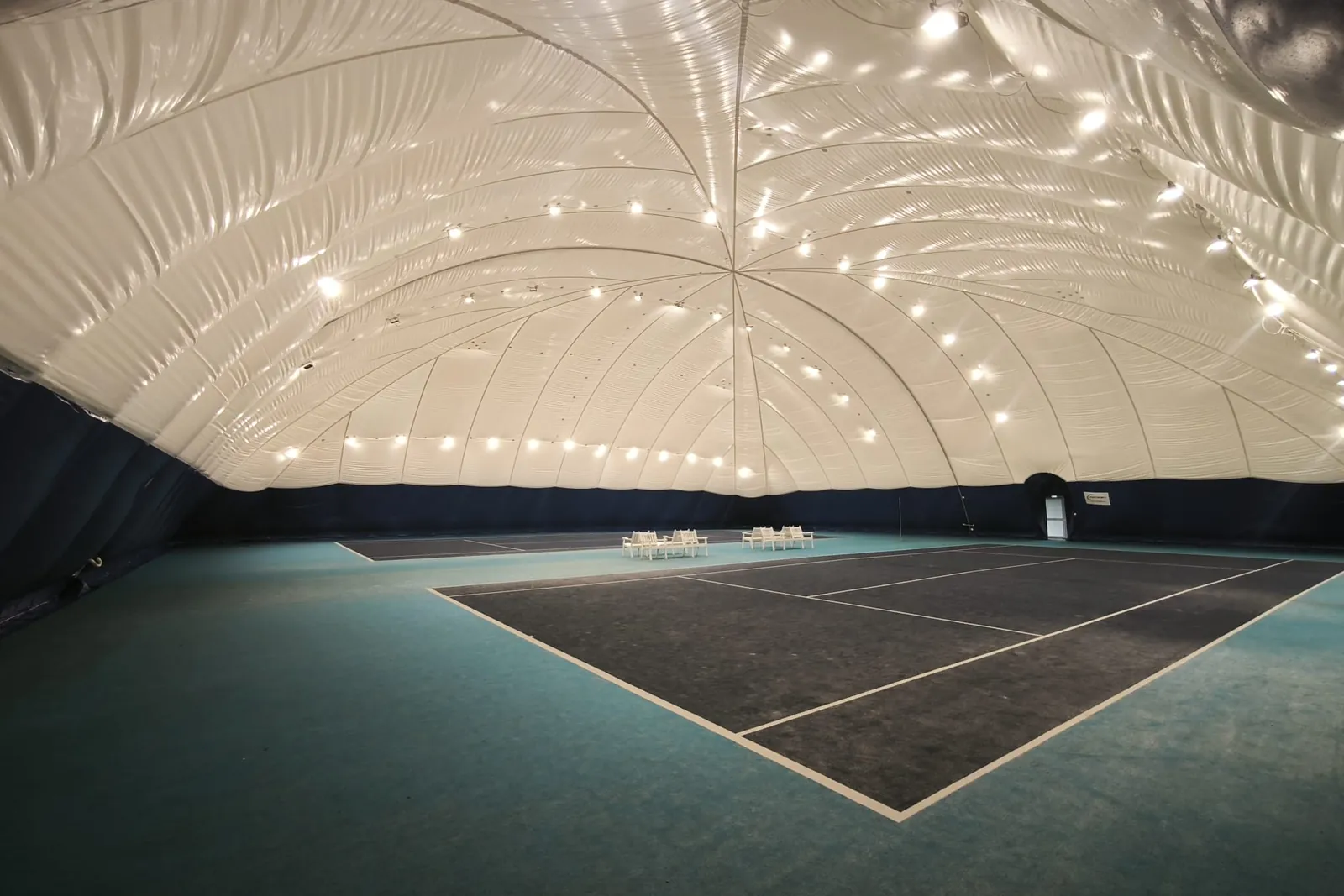
Markvartovice, a village of about 2,200 people just north of Ostrava in the Czech Republic, covers its two outdoor tennis courts with a CENTAURY+ air dome every winter. The 36 × 36 m dome goes up in October and comes down in April, so the courts are indoor courts in winter and outdoor courts again in summer.
Our remote monitoring shows how the dome did in its first winter. Between bookings it is set to a standby temperature of 3 °C; for play it is set to 15 °C, and the median warm-up from standby to 14 °C took 31 minutes. During play the median indoor temperature was 14.5 °C, and on the coldest morning, at about −12 °C outside, the dome stood steady at its normal pressure.
Table of Contents
- Project at a Glance
- What the Dome Gives the Village
- The Village and the Timeline
- A Seasonal Dome: How the Year Works
- Two Courts in 36 × 36 m
- The Dome and Its Technology
- Safe in Wind, Snow and Power Cuts
- How Warm It Was in Winter
- What the Village and the Club Say
- What a Village Should Plan For
- Why Towns and Clubs Choose CENTAURY+
- How a Project With Us Runs
- More of Our Tennis Domes
- Frequently Asked Questions
- Get a Free Quote for Your Tennis Dome
Project at a Glance
| Location | Markvartovice tennis courts, Šilheřovická 492, 747 14 Markvartovice, Moravian-Silesian Region, Czech Republic |
|---|---|
| Use | Seasonal dome over two outdoor tennis courts: up in winter, taken down for the summer |
| First season | Winter 2025/26; second season since 17 October 2026 |
| Size | 36 × 36 m, height 10 m, volume about 9,100 m³ |
| Membrane | Double-layer membrane covering about 2,100 m² |
| Anchoring | 100 chemical anchors in concrete and a 144 m steel tube running through the membrane edge |
| Air handling and heating | Warm-air unit with 24,000 m³/h of air and up to 397 kW of heat output; 7.5 kW fan |
| Backup | Diesel-powered backup air unit, 14,000 m³/h, fuel for about 12.5 hours |
| Lighting | 52 LED luminaires, 100 W each |
| Changing rooms | Container changing rooms next to the dome |
| Operation | CENTAURY+ control system with remote monitoring; normal inflation pressure 160 Pa |
What the Dome Gives the Village
The dome turns two summer courts into a heated indoor tennis venue for half the year, without a permanent building and without giving up outdoor tennis in summer.
- Tennis all winter. From October to April the tennis club, schools and the public can book the courts in any weather. In the first winter the dome was heated for play on almost every day in our record, typically for about six and a half hours a day.
- No permanent hall building. The village gained indoor winter courts without building a conventional sports hall, and the changing rooms are in containers next to it. The dome still needs regular service, as explained below.
- Heat only when booked. The dome was at playing temperature for only 28% of the first winter; the rest of the time it waited at its 3 °C standby.
The Village and the Timeline
Markvartovice lies in the Hlučín area of the Moravian-Silesian Region, close to Ostrava and the Polish border. The two tennis courts on Šilheřovická Street are used by the local tennis club, schools and the public, and are booked through an online booking system.

Want to play under the dome? In winter the courts can be booked through the village's online booking system. Bookings outside the regular hours should be made at least a day in advance, so that the heating can be started in time. The booking link, the visitor rules and contacts are on the village's page about the tennis courts (in Czech).
The project ran like this:
- 2025: CENTAURY+ delivers the dome with its technology; the anchors are set into the concrete around the courts.
- Autumn 2025: The dome is erected over the two courts for its first season.
- Winter 2025/26: The first season. The dome comes down in mid-April 2026.
- 17 October 2026: The dome goes up again for its second season.
A Seasonal Dome: How the Year Works
A seasonal dome gives a village winter tennis on the courts it already has: the dome stands over the courts from autumn to spring, and in summer it is folded and stored. The same membrane, air unit and control system serve every season.
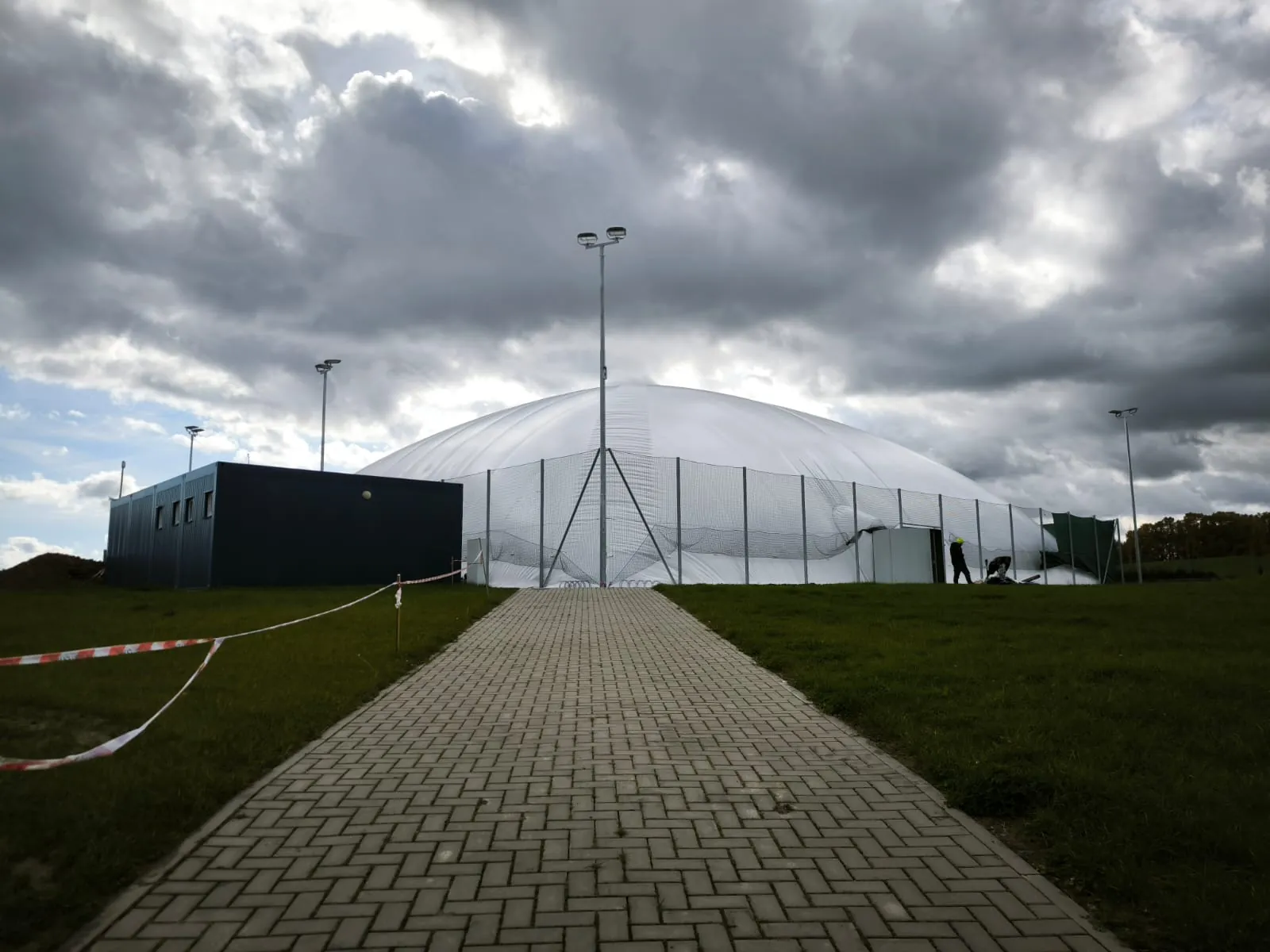
The Seasonal Cycle
- Autumn: erection. The anchors stay in the concrete all year. The crew lays out the membrane, threads the steel tube through the membrane edge and the anchor eyelets, connects the air unit and inflates the dome. Then the lighting, heating, pressure and backup are checked.
- Winter: operation. The dome is inflated day and night. It is heated to playing temperature for bookings and kept at a low standby temperature in between.
- Spring: dismantling. The dome is deflated in dry weather, cleaned, folded and packed.
- Summer: storage. The membrane is stored dry and protected until the next autumn, and the courts are played outdoors.
Why the Anchoring Matters for a Seasonal Dome
In Markvartovice the membrane edge is held by a steel tube, 144 m long, which runs through a sleeve along the edge of the membrane and through eyelets fixed to 100 chemical anchors in the concrete around the courts, about one anchor every 1.4 m. This is the standard CENTAURY+ solution for seasonal domes: it is quick to assemble and to take apart, and the anchors stay in place from one season to the next. Domes that stay up all year usually get a concrete ring beam with steel profiles instead. Both solutions are compared in our tennis dome buyer's guide.
Seasonal or Year-Round?
| Question | Seasonal dome (like Markvartovice) | Year-round dome |
|---|---|---|
| Courts in summer | Outdoor courts | Indoor courts |
| Membrane handling | Erection in autumn, dismantling, folding and dry storage in spring | None, but regular inspection all year |
| Anchoring | Steel tube through eyelets on anchors that stay in place | Usually a concrete ring beam with steel profiles |
| Running costs | Energy and staff only in the covered season, plus the cost of each dismantling and erection | Electricity for the fans all year; summer heat may need ventilation |
| Best for | Villages and clubs that want outdoor tennis in summer and have space to store the membrane | Clubs with enough indoor bookings all year |
Seasonal handling has its own cost: in our air dome price guide we estimate €5,000–15,000 per dismantling and re-erection cycle, depending on the size of the dome. Other ways to protect a court in winter, from covers to domes, are compared in our guide on how to cover a tennis court for winter.
Two Courts in 36 × 36 m
A 36 × 36 m dome is a compact size for two tennis courts side by side, with room for the run-off around them and for the entrance. In Markvartovice the dome is 10 m high at the top, which leaves enough room for lobs over the middle of both courts. Because the roof is curved, the air volume of about 9,100 m³ is roughly 70% of a 36 × 36 × 10 m box, and the membrane surface of about 2,100 m² is about 1.6 times the footprint.

How the number of courts translates into the size of a dome can be seen in our own projects:
| Courts | Example | Dome size |
|---|---|---|
| 1 court | TK Raketa, Slovakia | 36.6 × 18.2 m, 8.5 m high |
| 2 courts | Markvartovice, Czech Republic | 36 × 36 m, 10 m high |
| 3 courts | Lysá nad Labem, Czech Republic | 55.3 × 37 m, 10 m high |
| 4 courts | Mauthausen, Austria | 62 × 36 m, 10 m high |
The final size of any dome follows the court layout, the run-off the owner wants and the space outside the courts for the anchors, the entrance and the plant room. Recommended court and run-off dimensions are in our indoor tennis court dimensions table. On an existing site, the fence, the floodlight masts and the paths around the courts also count: in Markvartovice the dome stands inside the court fence, which stays in place.
The Dome and Its Technology
Double-Layer Membrane
The membrane covers about 2,100 m² and has two layers of PVC-coated polyester with an air gap between them. The air gap insulates: a double-layer membrane can cut heating costs by up to 30% compared with a single layer. How the insulation of a dome translates into heating costs, including a worked example for a two-court 36 × 36 m dome, is explained in our air dome U-value and heating-cost guide.
Air Handling and Heating
A warm-air unit outside the dome supplies 24,000 m³ of air per hour and up to 397 kW of heat for the 9,100 m³ inside, through flexible ducts into the dome. The fan has a 7.5 kW motor. The same unit keeps the dome inflated and heats it, and the control system decides how much of each is needed. More on the options is in our guide to air dome heating, and on how the pressure is kept stable in our article on pressure regulation in air domes.
Lighting
The courts are lit by 52 LED luminaires of 100 W each, 5.2 kW in total.
Changing Rooms and Entrance
Players enter the dome through doors in the membrane, next to the container changing rooms.
Our Own Control System
The dome is run by a CENTAURY+ control system with our own software. It keeps the inflation pressure, switches between standby and playing temperature, and records the indoor temperature, the setpoint and the pressure. We see the same data, so we can help the operator remotely.
Safe in Wind, Snow and Power Cuts
A diesel-powered backup air unit keeps the dome inflated if the power fails, and the control system holds the pressure steady in wind; for heavier snow there is a clear procedure. Every CENTAURY+ dome comes with the following as standard:
- Diesel-powered backup air unit. It starts automatically after a power cut or a fault of the main air unit and keeps the dome inflated. In Markvartovice it delivers 14,000 m³ of air per hour, and its tank holds fuel for about 12.5 hours.
- Overpressure protection. If the pressure rises above the safe limit, air is released automatically.
- Safe exits. Emergency exits with illuminated signs that stay lit during a power cut.
- Certified membrane and design. Our structures comply with EN 13782 for temporary structures, and the wind and snow loads are checked for each site.
The Markvartovice dome runs at 160 Pa. In the first winter the pressure was within 5 Pa of that value 95% of the time. The strongest gusts in the weather data for the village while the dome was up, about 60 km/h in early April 2026, did not move it: the pressure stayed at 159 Pa.
Light snowfall is usually not a problem while the dome is heated: the snow melts on the warm membrane or slides off the curved roof. Standby is for dry winter weather. When snow is falling, the operator follows the snow procedure for the dome, whatever the booking schedule says. In our domes this includes raising the heating setpoint to at least 15 °C, so the snow loosens where it touches the membrane and slides off. The full procedure, step by step, is in our guide on how to remove snow from an air dome.
How Warm It Was in Winter
The figures below cover the first season, from 19 December 2025, when the monitoring started, until the dome came down in mid-April 2026. The dome measures only the indoor temperature; outdoor temperatures are hourly weather data for Markvartovice.
The village heats the dome to 15 °C for play. Between bookings it is set to a standby temperature, usually 3 °C, and the fans keep the dome inflated at its normal pressure the whole time. In the first winter the dome was set to playing temperature for 28% of the time.
Playing Temperature, Also in Frost
The figures below refer to the hours of play, when the dome was set to 15 °C. We leave out the first hour after each switch-on, while the dome is still warming up, which leaves 503 hours.
In these hours the median indoor temperature was 14.5 °C. It was at least 13 °C for 99% of the time and at least 14 °C for 78% of the time. In frost the court was a little cooler:
| Outdoor temperature | Hours of play | Median indoor temperature |
|---|---|---|
| Above +10 °C | 113 | 15.6 °C |
| +5 to +10 °C | 95 | 14.7 °C |
| 0 to +5 °C | 128 | 14.3 °C |
| −5 to 0 °C | 143 | 14.0 °C |
| Below −5 °C | 24 | 13.6 °C |
The hour of play with the coldest outdoor air was on 10 January 2026 at 9:00, at −9.5 °C outside and about 13 °C on the court. For winter tennis in a dome, 13 to 15 °C is a normal playing temperature. If you want a higher temperature in hard frost, tell us when you ask for a quote and we will size the heating for it.
The Coldest Morning: 11–12 January 2026
Indoor temperature from the dome's record, outdoor temperature from hourly weather data, from the morning of 11 January to the evening of 12 January. Between the two blocks of play the dome was on standby.
Orange: indoor air · Blue: outdoor air · Shaded: dome set to 15 °C.
On 11 January the dome was heated for play in the morning and held about 14 °C at around −4 °C outside. After play it went back to standby, and in the evening the standby setpoint was lowered to 2 °C. Overnight the outdoor air fell to about −12 °C at 8:00 on 12 January, the coldest moment of the season, and the dome held about 2 °C inside, at its normal 160 Pa. At 12:45 the dome was set to 15 °C, with about −6 °C outside and 1.5 °C inside. Fifty-four minutes later the court was at 13 °C, and through the afternoon, at −6 to −7 °C outside, it held about 13.5 °C until play ended at 19:48.
Warm-Up: Usually Within 40 Minutes
For each block of play we measured how long it took from switch-on until the indoor air reached 14 °C, within 1 °C of the setpoint. Typically the warm-up started at about 5 °C inside.
| Warm-up from standby to 14 °C | Time |
|---|---|
| Typical (median of 131 warm-ups) | 31 minutes |
| 3 out of 4 warm-ups | 39 minutes or less |
| In frost, below 0 °C outside (median of 57) | 39 minutes |
| In hard frost, below −5 °C outside (8 warm-ups) | about an hour to reach 13 °C (median 58 minutes), longer to reach 14 °C |
Our operating manual recommends starting the heating 30 to 45 minutes before the first booking. The data from Markvartovice confirm that this is enough on most winter days; on days of hard frost it is worth starting about an hour before play.
Standby Between Bookings
Outside bookings, and every night, the dome is held at a low standby temperature, in 80% of the standby time at 3 °C. The median indoor temperature on standby was 4.3 °C. In the 171 standby hours when it was colder than −5 °C outside, the median was 2.7 °C, and the indoor air never fell below 1 °C. Standby keeps the dome above freezing on little heat, so each warm-up starts from about 5 °C instead of from the outdoor temperature.
The Second Season So Far
The dome went up again on 17 October 2026. By 10 November it had been heated for 135 hours of play, with a median indoor temperature of 14.6 °C. How Markvartovice compares with our other domes through a whole winter is shown in our winter study of air domes.
What the Village and the Club Say After the First Winter
The village and its tennis club wrote about the dome in the village newsletter, Markvartovický zpravodaj.
“The first season of the air-supported tennis dome made me very happy. It proved to be a good investment – the dome was full of life, players of all generations used it, and it did what we expected of it.”
The mayor of Markvartovice, Markvartovický zpravodaj 2/2026 (translated from Czech)
“There are currently 91 people registered in the online system. It is one of the best domes in the wider area, and there is demand for it.”
Tennis club Markvartovice, Markvartovický zpravodaj 1/2026 (translated from Czech)
Want to know how a dome would perform over your courts? With a free quote you get the price and an estimate of the heating and running costs for your location.
Request a free quoteWhat a Village Should Plan For
A seasonal dome needs what any sports hall needs: someone on site, service and energy. On top of that, it has to be put up in autumn and taken down in spring.
- Someone on site in the season. Someone has to open the dome and the changing rooms, start the heating for bookings, follow the snow procedure when snow is falling and check the dome after strong wind.
- Bookings. Markvartovice takes bookings online. Fixed weekly slots for the club and bookable hours for the public fill the dome and tell the operator in advance when to heat it.
- Erection and dismantling. Plan the dates, the crew and the weather window every autumn and spring, or leave it to us. The membrane must be dry when it is folded.
- Storage. The folded membrane needs a dry, protected place for the summer.
- Service before every season. The air unit, the heating and the backup unit get their check before the dome goes up, and the safety inspections required in your country are done before the first booking.
- The backup unit. In winter the diesel backup needs fuel with an anti-freeze additive and regular fuel checks, so it is ready for a power cut.
A seasonal or removable dome does not automatically avoid permits. What is usually needed, and how an owner can prepare it, is explained in our air dome planning permission guide. The whole installation sequence, from the site survey to commissioning, is described in our guide on how to install an air dome.
Why Towns and Clubs Choose CENTAURY+
CENTAURY+ has built more than 100 air domes, and we design, make and deliver each one with all its technology. This is what villages, towns and clubs get from us:
What the Price Includes
The turnkey dome price includes the membrane, air handling and pressure control, a diesel-powered backup air unit, heating, LED lighting and assembly. Prices exclude VAT; foundations and anchoring, earthworks, utility connections, permits and the court surface are quoted separately.
Long Life and a Clear Warranty
Standard membranes are specified for around 20 years, premium Low Wick membranes for around 30 years. The warranty is 5 years on the standard membrane, typically 10 years or more on Low Wick, and 2 years on the other components.
Our Own Controls, ISO 9001
Remote monitoring, an app and automatic SMS alerts come with every dome, so the operator does not have to be on site to know the pressure and temperature. CENTAURY+ is ISO 9001:2015 certified.
How a Project With Us Runs
- Free quote and a dome made to measure. You get the price and an estimate of the heating and running costs, and choose the size, the entrance, the plant room and seasonal or year-round use.
- Documents for approval and tender. We provide the technical description and dome data for the structural design, the permit and public procurement, and the certificates, test records and operating manual for the safety inspection.
- Production and site preparation. We make the membrane, the air unit, the heating and the controls; on site the anchors are set, and power and heating supply are brought to the plant room.
- Installation and commissioning. Once the site is ready, the dome itself is erected and inflated within a few hours. The complete installation, with the pressure, heating, lighting and backup set and tested, usually takes 2–3 days and no more than 5.
- Handover and every season after. You get the operating manual, the certificates and access to the control system. We watch the dome with you, help remotely and, if you wish, take care of dismantling in spring and erection in autumn.
More of Our Tennis Domes
Other CENTAURY+ tennis domes with their own case studies:
- Single-court tennis dome of TK Raketa, Slovakia. A small dome over one court next to a hotel, with winter data.
- Three-court tennis dome in Lysá nad Labem, Czech Republic. A seasonal 55.3 × 37 m dome over three courts, delivered with the court surface.
- Clay-court tennis dome in Mauthausen, Austria. A seasonal dome over the four clay courts of the Danubis tennis centre.
- Multi-sport dome in Leopoldov, Slovakia. A town dome over two tennis courts that is also used for five other sports.
More completed projects are in our gallery.
Frequently Asked Questions
The seasonal dome over two tennis courts in Markvartovice, Czech Republic, is 36 × 36 m and 10 m high, with a volume of about 9,100 m³. That leaves room for two courts side by side, the run-off around them and the entrance. For one court a dome of about 36 × 18 m is enough, for three courts about 55 × 37 m.
A seasonal tennis dome covers outdoor courts only in the cold months. In Markvartovice the dome goes up in October and comes down in April; in summer the membrane is folded and stored dry, and the courts are outdoor courts again. The anchors stay in the concrete all year, and the membrane edge is held by a steel tube through eyelets on the anchors, which makes erection and dismantling quick. CENTAURY+ offers seasonal dismantling and re-erection for the domes it has installed.
In the Markvartovice dome, heated to 15 °C for play, the median indoor temperature during play in winter 2025/26 was 14.5 °C, and 99% of the time it was at least 13 °C. At −5 to 0 °C outside the median was 14.0 °C, and in the hour of play with the coldest outdoor air, −9.5 °C, it was about 13 °C on the court. Between bookings the dome is set to a standby temperature, usually 3 °C.
In Markvartovice the warm-up from standby, at about 5 °C inside, to 14 °C took a median of 31 minutes, and 3 out of 4 warm-ups took 39 minutes or less. Below 0 °C outside the median was 39 minutes; in hard frost below −5 °C it took about an hour to reach 13 °C. We recommend starting the heating 30 to 45 minutes before the first booking, and about an hour before play on days of hard frost.
Every CENTAURY+ dome has a diesel-powered backup air unit that starts automatically after a power cut or a fault of the main air unit and keeps the dome inflated. In Markvartovice the backup unit delivers 14,000 m³ of air per hour, and its tank holds fuel for about 12.5 hours.
A turnkey CENTAURY+ dome over one tennis court (36 × 18 m) costs €100,000–150,000, excluding VAT; the price for a 36 × 36 m dome over two courts is in our full price list. Foundations and anchoring, earthworks, utility connections, permits and the court surface are quoted separately. A seasonal dome also needs one dismantling and re-erection per year, which we estimate at €5,000–15,000 per cycle, depending on the size.
Get a Free Quote for Your Tennis Dome
Send us the number and size of your courts, the location and the months you want to play, and with a free, no-obligation quote we will tell you:
- what a dome for your courts will cost,
- what size fits your courts and your plot,
- whether a seasonal or a year-round dome suits you better,
- what heating and running costs to expect for your location and opening hours.
Want to see prices first? A turnkey CENTAURY+ dome over one tennis court (36 × 18 m) costs €100,000–150,000, excluding VAT. Prices for the larger sizes, including two-court domes, are in the full price list, which we send to your email.
Indicative Price List
| Dimensions (m) | Area (m²) | Price from | Price to | Avg. price/m² |
|---|---|---|---|---|
| 36 × 18 | 648 | €100k | €150k | €193 |
| 25 × 40 | 1,000 | |||
| 36 × 36 | 1,296 | |||
| 54 × 36 | 1,944 | |||
| 72 × 36 | 2,592 | |||
| 40 × 70 | 2,800 | |||
| 115 × 80 | 9,200 |
Get the Full Price List by Email
All 7 dome sizes from 648 m² to 9,200 m², with price ranges and average price per m².
* k = thousand; prices exclude VAT. Average price per m² calculated from midpoint.
Sources
- Village of Markvartovice: tennis courts, operating rules and booking, in Czech.
- CENTAURY+ remote monitoring of the dome, 19 December 2025 to mid-April 2026 and 17 October to 10 November 2026.
- Statements of the village and the club: Markvartovický zpravodaj 1/2026 (p. 16) and 2/2026 (p. 2), in Czech.
- Outdoor temperatures and wind gusts: hourly weather data for Markvartovice from Open-Meteo.