
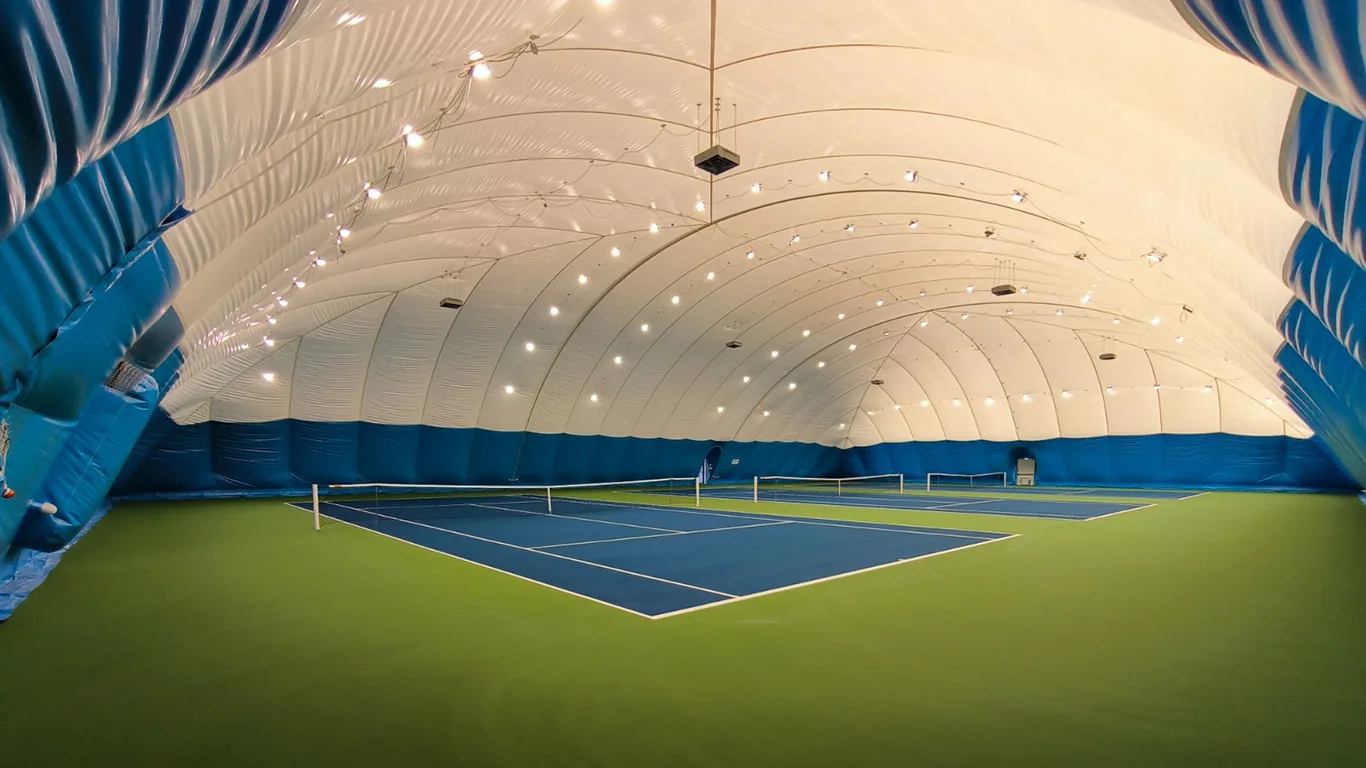
A tennis dome is an air-supported enclosure that creates a clear-span indoor playing space over one or more courts. Fans maintain a small controlled overpressure, while an anchored membrane forms the roof and walls without columns between the courts. Tennis domes are also called air domes, tennis bubbles or inflatable tennis court covers.
For a club, school or court owner, the buying decision is not simply about the membrane. A usable facility combines the enclosure, anchoring, entrances, air-handling equipment, climate control, lighting, emergency power, controls and operating procedures. The right specification depends on the court layout, climate, operating season, approvals and local energy costs.
In short: a turnkey CENTAURY+ tennis dome over one court (36 × 18 m) costs EUR 100,000–150,000, excluding VAT. Once the foundations are ready, it is erected within 5 days. A double-layer membrane is standard, and the membrane is specified for around 20 years, or around 30 years with premium Low Wick membrane. Prices for domes over two or more courts are in the full price list, which we send by email.
Table of Contents
- How a Tennis Dome Works
- When a Dome Fits the Project
- Seasonal vs Year-Round Use
- What a Complete System Includes
- Tennis Dome Cost Drivers
- Operation, Weather and Maintenance
- How to Compare Proposals
- From Survey to Handover
- Frequently Asked Questions
How Does an Air-Supported Tennis Dome Work?
The air-handling unit supplies enough air to keep the internal pressure slightly above the outdoor pressure. That pressure tensions the membrane and creates the dome's shape. Players do not feel a strong wind inside: normal entry is through an airlock or revolving-door arrangement that limits pressure loss.
Pressure is only one part of the system. The controls coordinate fans, sensors and alarms; the anchoring transfers membrane forces to the ground; heating and ventilation manage the indoor environment; and an emergency unit supports the pressure system if the normal supply is interrupted. Every component must be designed as part of one project rather than purchased as an unrelated accessory.
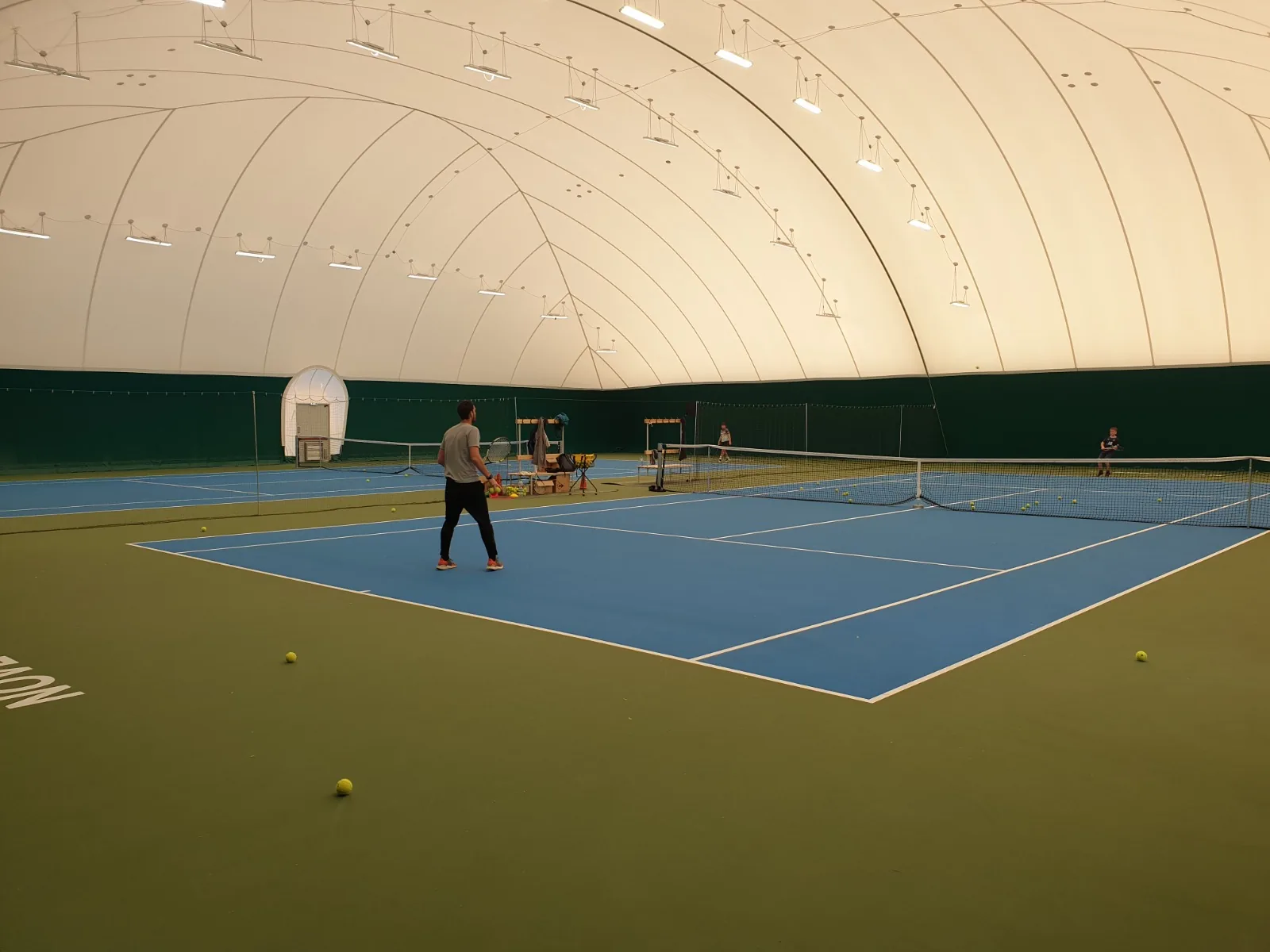
A clear-span interior keeps structural columns outside the playing area.
Core CENTAURY+ System Elements
- Double-layer membrane as standard: the insulating air gap of about 300 mm between the two layers can cut heating costs by up to 30% compared with a single-layer membrane.
- Air-handling and pressure control: fans, sensors and variable-speed control keep the internal overpressure between 130 and 300 Pa, depending on the weather.
- Airdome Guard controls: the system measures wind speed in real time and automatically raises the pressure to stiffen the dome in strong wind.
- Emergency backup: a diesel-powered backup air unit starts automatically if the mains supply fails or the main air unit stops.
- Certified membrane: fire classification B-s2,d0 to EN 13501-1; the membrane material itself is rated for temperatures from −30 to +70 °C.
- Ball visibility: the inside of the dome is usually white, and a coloured contrast band runs around the bottom of the walls, where the play happens, so the ball does not blend into the membrane. Blue and dark green are the most common choices, but the club decides; a custom RAL shade is possible with a minimum membrane order of around 3,000 m², which can add cost and lead time.
- Project-specific anchoring: the solution is engineered for the ground, geometry and local wind and snow design conditions.
- Tennis lighting and access: court lighting, airlocks, emergency exits and equipment access are configured around the intended use.
When Is an Inflatable Tennis Court Cover a Good Fit?
Existing Outdoor Courts
A dome can convert suitable outdoor courts into a seasonal or year-round indoor venue without placing columns in the playing area. Drainage, surface condition and perimeter space still need a survey.
Multi-Court Clubs
A single clear-span envelope can cover several courts and shared circulation. The layout must reserve safe run-offs, court separation, entrances and technical zones. One example is the three-court tennis dome in Lysá nad Labem, which measures 55.3 × 37 m.
Demand-Led Expansion
Clubs can evaluate a dome where weather cancellations or winter demand justify additional covered hours, provided the business plan includes energy, staffing and maintenance.
A dome is not automatically the right answer for every site. A permanent hall may suit projects that require extensive fixed accommodation, conventional architecture or other non-sport uses. Before choosing the enclosure, define the complete facility brief. The separate indoor tennis court construction guide covers court dimensions, surfaces, foundations, drainage, HVAC and the full construction sequence.
Seasonal or Year-Round Tennis Dome?
Seasonal and year-round domes use the same air-supported principle, but they create different operating obligations. The intended model should be fixed before design and approval because it affects foundations or anchors, handling, storage, climate systems, staffing and lifecycle costs.
| Decision | Seasonal Dome | Year-Round Dome |
|---|---|---|
| Court experience | Indoor play during the covered season; outdoor play returns after removal. | Consistent enclosed environment throughout the year. |
| Handling | Planned erection, removal, inspection, cleaning, folding and dry storage. | No seasonal membrane handling, but continuous inspection and operation remain necessary. |
| Operating model | Energy and staffing follow the covered season; mobilisation costs recur. | Year-round energy, ventilation, maintenance and staffing must be budgeted. |
| Approvals | Seasonal or removable status does not automatically remove approval obligations. | The local authority may assess the structure and use as a long-term facility. |
| Best suited to | Clubs that value outdoor summer courts and have a reliable handling and storage plan. | Sites with sustained indoor demand and a complete long-term operating plan. |
The operating model also decides the anchoring. For seasonal domes, steel tubes run through a sleeve at the membrane edge and through eyelets fixed to the anchors, so the dome can be erected and removed quickly. Year-round domes are clamped to the foundation with steel L-profiles, which seal best and are the most robust option. For a fully temporary installation, the dome can be anchored to mobile precast concrete blocks that are removed together with the structure.
If the main objective is winter protection for existing courts, see the detailed guide to covering a tennis court for winter.
What Should a Complete Tennis Dome System Include?
Low headline quotations are difficult to compare because suppliers may include different scopes. Ask each bidder to identify what is included, excluded, designed by others or priced as an option.
- Site survey and verified court layout
- Design criteria for local wind, snow and ground conditions
- Membrane type, layers, translucency and fire classification
- Foundations, anchors and perimeter interfaces
- Main air-handling and pressure-control equipment
- Emergency backup, changeover and alarms
- Heating, ventilation and humidity strategy
- Player entrances, emergency exits and service access
- Lighting design and control
- Electrical supply, fuel supply and utility connections
- Delivery, lifting, installation and commissioning
- Training, manuals, inspections and maintenance
What Determines Tennis Dome Cost?
A turnkey CENTAURY+ tennis dome over one court (36 × 18 m, 648 m²) costs EUR 100,000–150,000, excluding VAT, or about EUR 193 per m². That includes the double-layer membrane, air handling and pressure control, a diesel-powered backup air unit, heating, LED lighting and assembly. Foundations and anchoring are not included in the price: if your site already has a suitable foundation, nothing more is needed; if not, we can build the foundation and anchoring for a separate quote. The 5-day erection time starts once the foundation is ready. Not included: VAT, land preparation and earthworks, utility connections, building permits and the court surface inside the dome, which are quoted separately. Prices for domes over two or more courts are in the price list below.
Indicative Price List
| Dimensions (m) | Area (m²) | Price from | Price to | Avg. price/m² |
|---|---|---|---|---|
| 36×18 | 648 | €100k | €150k | 193 € |
| 25×40 | 1 000 | |||
| 36×36 | 1 296 | |||
| 54×36 | 1 944 | |||
| 72×36 | 2 592 | |||
| 40×70 | 2 800 | |||
| 115×80 | 9 200 |
Get the full price list by email
All 7 hall sizes from 648 m² to 9,200 m², with price ranges and average price per m².
* k = thousand; prices exclude VAT. Average price per m² calculated from midpoint.
Two projects with the same number of courts can still differ in footprint, climate loads, foundations, access and utility works, so the final price is set for the actual site. The table below shows the main cost groups and what to ask about each.
| Cost group | Typical inclusions | Questions to ask |
|---|---|---|
| Structure | Covered footprint, geometry, membrane specification, fabrication and structural design. | Which climate loads and design assumptions are included? |
| Site works | Survey, groundworks, drainage, foundations or anchors, hardstanding and access. | Which works remain with the client or local contractor? |
| Technical equipment | Air handling, controls, backup power, heating, ventilation, lighting, entrances and exits. | Is the equipment sized for the agreed use and local utilities? |
| Delivery and installation | Freight, cranes or lifting, labour, accommodation, testing, commissioning and training. | Are taxes, permits and local attendance included? |
| Operation | Electricity, heating or cooling, maintenance, inspections, cleaning, seasonal handling and replacement reserves. | Which load assumptions support the forecast? |
Compare capital and operating costs together. A double-layer membrane improves thermal resistance compared with a single layer, but actual energy use still depends on dome area, weather, temperature target, air leakage, ventilation, operating hours, tariffs and control settings. Electric heating is economical only for very small domes, such as a single court; larger domes are usually heated with gas, hot water from a nearby source or wood pellets. For a sense of scale, the worked example in our U-value and heating-cost guide puts the heating energy for a two-court 36 × 36 m dome at about EUR 4,000–10,000 per season (October to April, +15 °C for eight hours a day, EUR 0.08/kWh, illustrative climate profile). Use the air dome prices guide for indicative published ranges and stated inclusions, then request a site-specific quotation.
Operation, Weather Safety and Maintenance
An air-supported structure is an active building system. The club needs a trained operator, documented normal and emergency procedures, maintenance records and clear responsibility for monitoring alarms and weather conditions.
Pressure and Backup Power
The main fans maintain the operating pressure continuously. Variable-speed control can match fan output to demand, while the emergency arrangement supports the system if normal power or equipment is interrupted. On CENTAURY+ domes a diesel-powered backup air unit starts automatically if mains power fails, and even without power an undamaged membrane comes down only very slowly. Backup capacity, automatic changeover, fuel reserve and alarm escalation are specified and tested for the project. The technical guide to pressure regulation in air domes explains this system in more detail.
Wind and Snow
In normal operation a CENTAURY+ dome runs at about 160–170 Pa. Our winter monitoring data from a CENTAURY+ pool dome show what this looks like in practice: at −0.9 °C outside, the dome held 21.5 °C inside at a steady 165 Pa, and sunshine kept the heating off for almost eight hours. The control system measures wind speed in real time and raises the pressure automatically: to 200 Pa above about 40 km/h and to 300 Pa above about 100 km/h. At 300 Pa the dome is designed for a snow load of 30 kg/m²; heating the interior to at least 15 °C helps the snow slide off. That figure looks low next to the design snow loads of conventional roofs, but an air dome is not meant to carry a lying snow cover: warm air under the curved membrane melts the snow from below and lets it slide off. In heavy snowfall the operator keeps the heating at 15 °C or more, opens the valves in the outer membrane so warm air reaches the outer layer, gently vibrates the seams to start the snow moving and clears snow away from the perimeter. Our guide on removing snow from an air dome covers the full procedure. Never deflate the dome while a storm is already blowing: a slack membrane is far more vulnerable than a fully pressurised one. A controlled deflation is planned only when an extreme-wind warning is issued and the storm has not yet arrived. The design wind and snow loads of the site are still verified for every project.
Indoor Climate and Court Surface
Temperature, humidity, ventilation and air movement affect both players and the court. Hard, clay and synthetic surfaces have different moisture and maintenance needs. Clay courts, for example, require controlled moisture; the ventilation and watering strategy must avoid both excessive drying and condensation. Lighting should be designed for the playing standard and checked for uniformity and glare.
Inspection and Service Life
Routine checks should cover membrane condition, seams, anchors, doors, fans, filters, belts, sensors, alarms, backup equipment and drainage around the perimeter. CENTAURY+ standard membranes are specified for around 20 years and premium Low Wick membranes for around 30 years; actual service life depends on UV exposure, weather, handling and maintenance. Low Wick is a more durable membrane and comes with an extended warranty, typically 10 years or more, against 5 years for the standard membrane. Ask for the exact product warranty, exclusions and required inspections in writing. The air dome lifespan guide provides a broader maintenance framework.
How to Compare Tennis Dome Proposals
Do not compare only the membrane price. Place bids in one table and normalise the scope before deciding.
| Compare | Evidence to request | Warning sign |
|---|---|---|
| Design basis | Dimensions, use, climate loads, ground assumptions and applicable standards. | Generic catalogue rating with no site criteria. |
| Thermal strategy | Membrane build-up, heating and ventilation concept, design conditions and load calculation. | Guaranteed percentage saving with no baseline or assumptions. |
| Safety systems | Control logic, alarms, backup capacity, emergency procedures and commissioning tests. | Claims that backup power removes every operational risk. |
| Complete scope | Responsibility matrix for foundations, utilities, delivery, installation, permits and local works. | Headline price with major interfaces left undefined. |
| Lifecycle support | Warranty terms, inspection schedule, spare parts, remote support and membrane replacement assumptions. | One lifespan claim without product or maintenance conditions. |
Project Insight from CENTAURY+
From our experience with air-supported halls, the most reliable proposal comparisons start with the same court plan, climate criteria and responsibility matrix for every bidder. When those inputs differ, a lower quotation may simply exclude foundations, utility work, emergency systems or commissioning that another supplier has included.
Two practical points come up on almost every tennis project. Net posts, fence sections and any other obstacles where the membrane will stand must be removable, and the club should confirm this before installation. And if the club plans electric heating, it pays off only for a single-court dome.
From Court Survey to Handover
- Define the brief: number of courts, playing standard, seasonal or year-round use, temperature target, opening hours and support spaces.
- Survey the site: confirm boundaries, court condition, levels, drainage, ground, access, utilities and neighbouring constraints.
- Develop the concept: set the clear-span geometry, entrances, emergency exits, equipment zones, foundations or anchors and court lighting.
- Confirm design and approvals: coordinate structural, civil, electrical, mechanical, fire-safety and accessibility requirements with the local project team and authority.
- Freeze the written scope: record inclusions, exclusions, performance criteria, responsibilities, programme, warranties and acceptance tests.
- Prepare the site and install: complete foundations, anchors, drainage and utilities before the membrane and technical equipment arrive; the dome itself is then erected within 5 days.
- Commission and train: test normal operation, alarms, backup changeover, lighting and climate controls; hand over manuals, procedures and maintenance schedules.
The dome itself is erected within 5 days once the site is ready, but it is only one stage of the full programme. Planning, engineering, approvals, manufacture, local works and commissioning should all appear in the schedule.
Request a Site-Specific Tennis Dome Proposal
Send the court layout, location, intended operating season and required indoor conditions. CENTAURY+ can then define the enclosure and technical scope for your project.
Discuss Your Tennis DomeFrequently Asked Questions
A turnkey CENTAURY+ tennis dome over one court (36 × 18 m) costs EUR 100,000–150,000, excluding VAT. The price includes the double-layer membrane, air handling and pressure control, a diesel-powered backup air unit, heating, LED lighting and assembly. VAT, foundations, anchoring, earthworks, utility connections, permits and the court surface are quoted separately. Prices for larger domes are in the full price list, which we send by email.
Often yes. A site survey must confirm the court condition, drainage, available perimeter, access, utilities and space for anchoring, entrances and technical equipment. The dome and its foundations or anchors are then engineered for that site.
Both operating models are possible when the structure and approval are designed accordingly. Seasonal use preserves outdoor summer play but requires planned installation, removal, handling and dry storage. Year-round use avoids seasonal handling but needs a permanent operating and maintenance plan.
A diesel-powered backup air unit starts automatically when the mains supply fails or the main air unit stops, and keeps the dome pressurised. Even without power, an undamaged membrane comes down only very slowly. The backup changeover and alarms are tested during commissioning.
Yes, within the design loads for the site. The control system measures wind speed and automatically raises the internal pressure in strong wind, up to 300 Pa. At 300 Pa the dome is designed for a snow load of 30 kg/m², and heating helps the snow slide off. The local design wind and snow loads are verified for every project.
Once the foundations are ready, a tennis dome is erected within 5 days. Design, approvals, manufacture, foundations, utilities and court works come before that and have their own schedule, so ask for a programme that shows every stage.
It may require planning, building, structural, fire-safety, accessibility or operating approvals. A seasonal or removable dome is not automatically exempt. Confirm the route with the competent local authority before ordering the structure.
CENTAURY+ standard membranes are specified for around 20 years, and premium Low Wick membranes for around 30 years. Actual service life depends on UV exposure, climate, handling, cleaning and maintenance, so follow the inspection schedule in the operating manual.
Choose the System Around the Court, Climate and Operating Plan
A tennis dome can turn weather-dependent courts into a dependable indoor venue, but the outcome depends on disciplined project definition. Select the structure only after the court layout, climate criteria, utilities, operating season, approvals and responsibilities are clear. Compare complete systems and written assumptions—not slogans, a membrane-only price or a universal return-on-investment claim.