
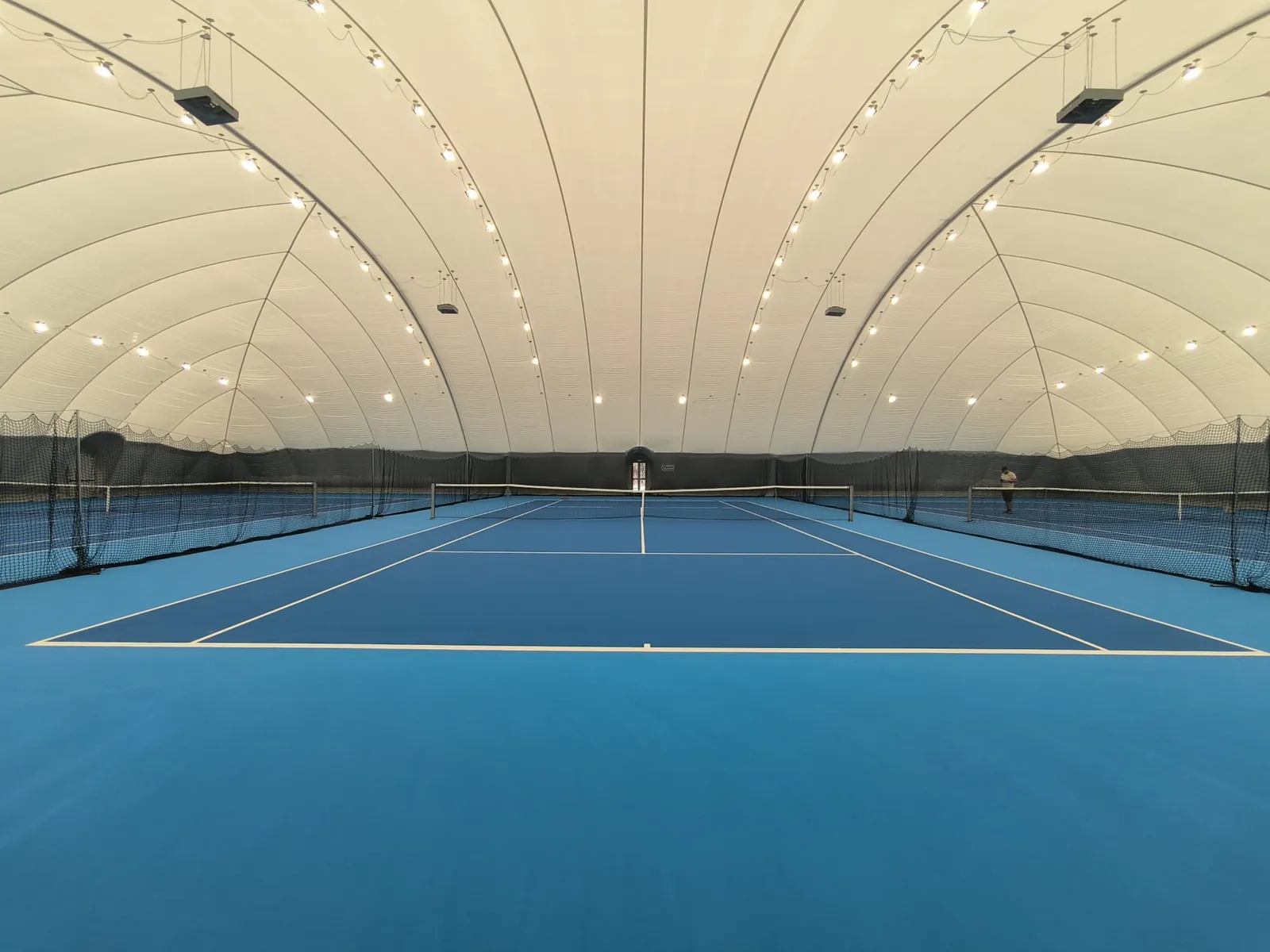
In Lysá nad Labem, Czech Republic, CENTAURY+ delivered a seasonal air dome over three tennis courts together with the court surface inside it, as one turnkey project. The dome measures 55.3 × 37 × 10 m. The courts have a cushioned, medium-paced CASALI surface (ITF Category 3) on an asphalt base, and the surface was laid only after the dome was standing and could be heated.
This article follows the project step by step: how the dome size was derived from the plot, what the technical equipment includes, why the surface went in after the dome and what the asphalt base had to meet. If you are comparing options for your own club, the tennis dome buyer's guide covers prices and how to compare proposals, and the indoor tennis court construction guide covers the full construction process.
Table of Contents
- Project at a Glance
- The Brief: Dome and Courts from One Supplier
- Sizing a Dome for Three Courts
- The Dome and Its Technical Equipment
- Erected in Two Days
- Dome First, Surface Second
- The Asphalt Base
- The CASALI Court Surface
- Lines, Posts and Nets
- What Other Clubs Can Take from This Project
- Frequently Asked Questions
Project at a Glance
| Location | Lysá nad Labem, Czech Republic |
|---|---|
| Use | Three tennis courts, seasonal (winter) operation |
| Scope | Turnkey delivery in two stages: (1) air dome with technical equipment, (2) court surface, line marking and court equipment |
| Dome size | 55.30 × 37.00 m, height 10.00 m |
| Membrane | Double-layer Sattler membrane, about 3,220 m² |
| Anchoring | 124 steel anchors in a concrete foundation plus a 177.8 m steel tubular anchoring frame |
| Air and heating | THSPORT 350 unit with a gas burner (at least 340 kW) and an 11 kW fan motor with a frequency inverter |
| Lighting | 84 LED luminaires, 100 W each, 185 lm/W |
| Court surface | CASALI Confosport T system, 7 layers on asphalt, 54.90 × 36.60 m = 2,009 m², ITF Category 3 |
| Dome erected | 17–18 June 2026, in 2 days; the court surface was laid afterwards inside the finished dome |
The Brief: Dome and Courts from One Supplier
The project covers three tennis courts with a seasonal air dome, so the courts can be played indoors through the cold season. A seasonal dome is erected for the winter and taken down for the summer.
The second requirement shaped the whole project: one supplier for both the dome and the court surface. The contract was split into two stages. The first stage was the dome with all its technical equipment. The second stage was the court surface with line marking and court equipment.
With a single supplier, one schedule covered both stages and one company was responsible for the interface between the dome and the courts. With two separate contractors, questions such as the timing, the edge detail or the cleanliness of the base can fall between them.
Sizing a Dome for Three Courts
A full-size air dome over three tennis courts is usually about 54 × 36 m. The Lysá nad Labem dome is 55.3 × 37 m, which gives players more room behind and beside the lines.
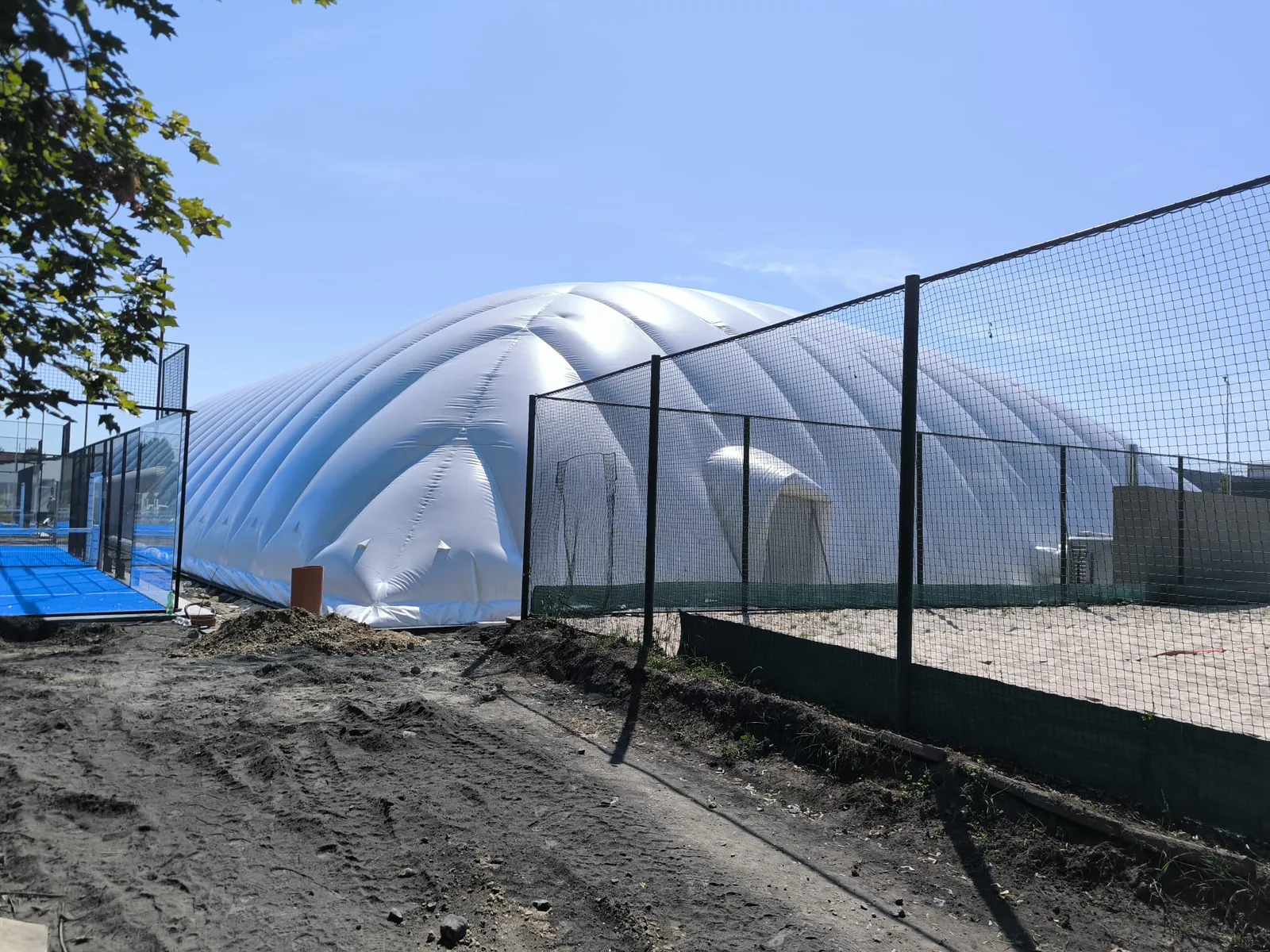
The size was not taken from a catalogue. The first design, 53.1 × 35.8 m, came from an analysis of the plot on map data: the distance to the plot boundary, the position of the plant room and the clearance to a neighbouring building. When the courts were then laid out larger, the dome was recalculated in proportion. The membrane area and the surface area both grew with the footprint, and the final dome came out at 55.3 × 37 m with a 10 m ridge height.
Two lessons follow for any multi-court project:
- Fix the court layout before ordering the dome. The dome follows the courts, not the other way round. A change in run-off or court spacing changes the membrane, the anchoring line and the surface area.
- Plan the space outside the courts. The anchoring, the entrances, the emergency exit and the plant room all need room outside the playing area, and that room has to fit inside the plot.
The recommended run-offs and total footprints per court are listed in the indoor tennis court dimensions table.
The Dome and Its Technical Equipment
The Lysá nad Labem dome uses the standard CENTAURY+ build-up: a double-layer membrane, a variable-speed air system with heating, LED lighting and a backup unit, all run by one control system.
Membrane and Anchoring
The membrane is a double-layer Sattler membrane with an area of about 3,220 m². The air gap between the two layers insulates the dome; the U-value and heating-cost guide explains how much that matters for the heating bill. The dome is held down by 124 steel anchors set in a concrete foundation and by a steel tubular anchoring frame 177.8 m long that runs around the perimeter.
Air Handling and Heating
Air and heat come from a THSPORT 350 unit with a gas burner of at least 340 kW. Its 11 kW fan motor runs through a frequency inverter, so fan output follows the actual demand instead of running at full speed all the time. The variable fan speed is what lets the pressure regulation raise the internal pressure in strong wind. A UIE 400 emergency unit supports the dome if the main supply is interrupted, and four destratifiers push warm air from under the roof back down to the courts.
Lighting
The courts are lit by 84 LED luminaires of 100 W each with an efficacy of 185 lm/W, a total installed lighting load of 8.4 kW for the whole dome.
Controls and Access
The dome is operated through a smart control system: a local LCD panel, SMS alerts and a mobile app. The lighting can be linked to the court booking system, so the lights follow the reservations. Players enter through two revolving doors of 180 × 220 cm, and a 132 × 200 cm emergency door completes the access.
Erected in Two Days
The dome over all three courts was erected in two days: work started on 17 June 2026 and the dome was standing on 18 June.
We install small and medium domes within five days once the site is ready, meaning the foundation, the anchors and the utilities are in place. Lysá nad Labem was well inside that: two days for a dome covering three full-size courts.
On a club where the courts are already finished, this is usually the whole story: once the dome is up, the courts can be played. Had the surface in Lysá nad Labem already been laid, the club could have started playing straight after the dome was erected. Here, the court surface was the second stage of the project and went in afterwards, inside the finished dome. What has to happen before installation day is described in the tennis dome buyer's guide.
Dome First, Surface Second
The court surface was laid only once the dome was erected, working and able to be heated. That was a condition in the contract, and it was the most important decision in the project.
A synthetic court surface is built up from several coatings, and each coat needs the right temperature and humidity to cure. Outdoors, the work depends on the weather: rain, dew, cold nights or strong sun can stop the crew or affect the result. Inside a heated dome, these risks largely disappear:
- No weather delays. Rain cannot cancel a working day, so the surface programme can be planned to the day.
- Stable curing conditions. The coatings cure at a controlled temperature and humidity.
- A clean base. Wind does not blow dust, leaves or sand onto a primed surface.
- Parallel commissioning. The dome and surface teams were on site at the same time, so the connection to the booking system could be tested while the surface was being laid.
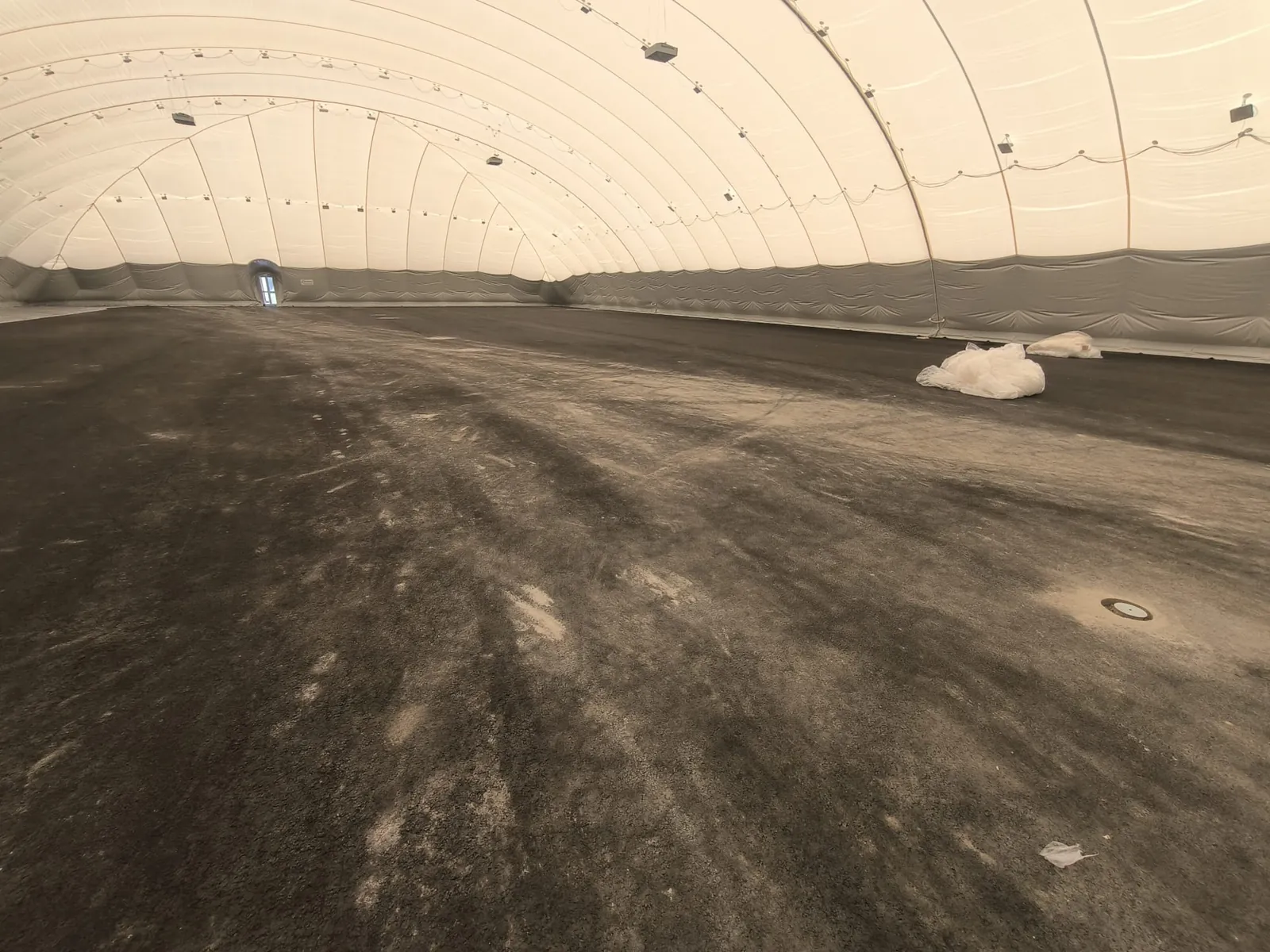
In June 2026 the dome was already inflated over the bare asphalt base, ready for the surface crew.
The Asphalt Base
The asphalt base was built by the client's contractor to a technical specification that CENTAURY+ issued in advance. Issuing the specification early matters: once the asphalt is in, any unevenness shows through every layer of the surface above it.
The points that decide the quality of the finished court are:
- Flatness: the base has to be level within the tolerances of the surface system, because the coatings follow the base.
- Curing: fresh asphalt needs time before a surface can be applied.
- Cleanliness: the asphalt must be completely clean before the first layer. Any extra cleaning is a separate job in the schedule.
- Preparation: before application, the asphalt in Lysá nad Labem was ground and primed so the first layer bonds properly.
The CASALI Court Surface
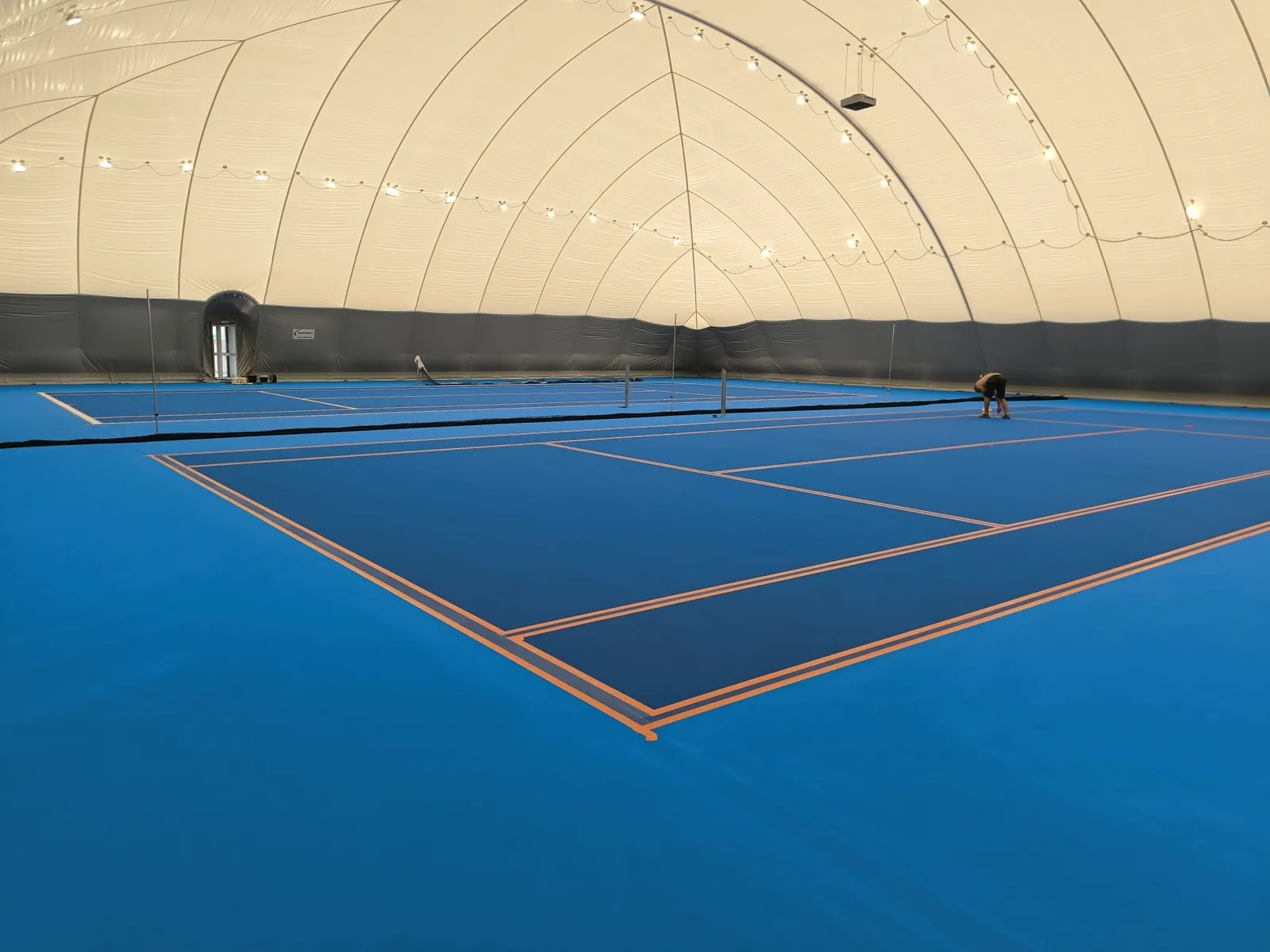
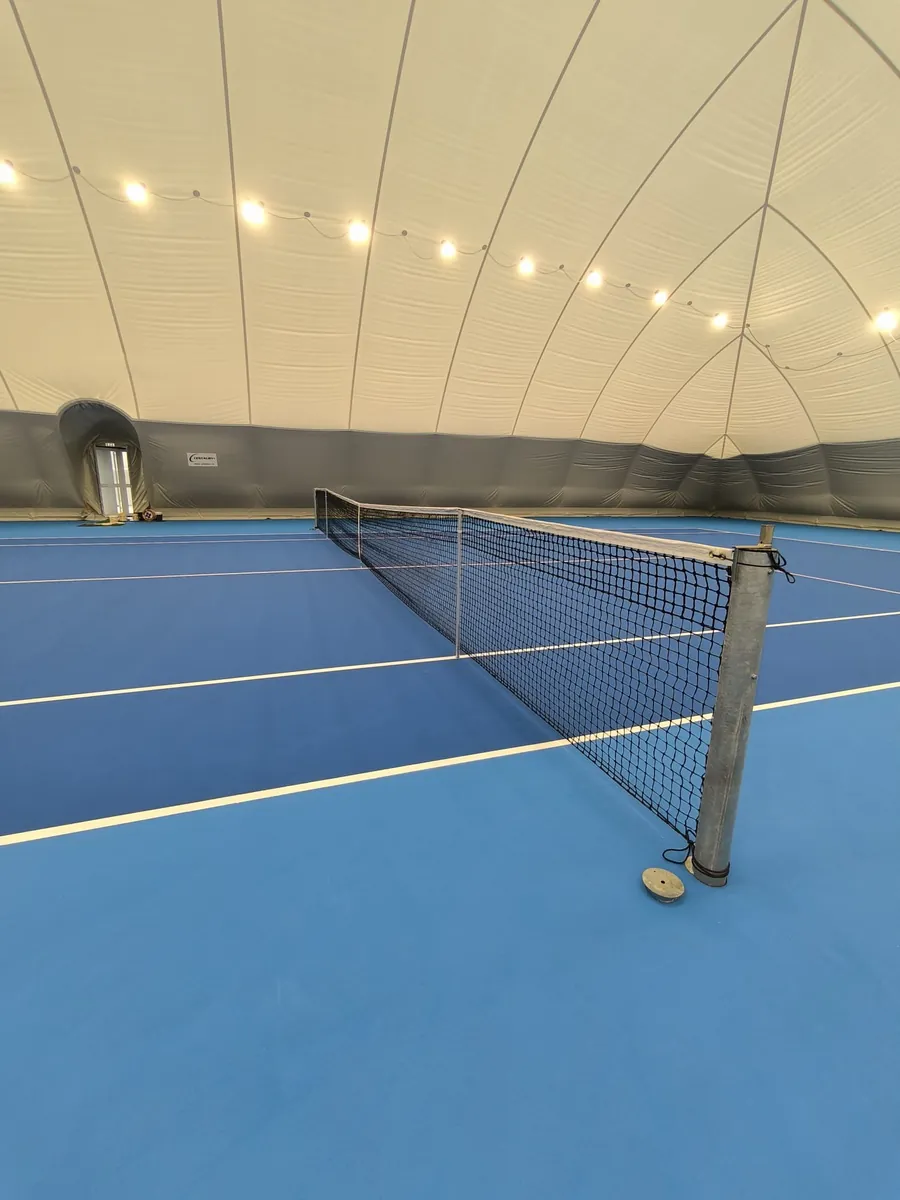
The courts have a CASALI Confosport T system: a 7-layer synthetic rubber surface on asphalt, 54.90 × 36.60 m, or 2,009 m² for all three courts. The playing area is blue.
Cushioned, Not Just Hard
The system combines the advantages of a hard court with the give of a synthetic court. A resilient rubber layer, laid in rolls on the primed asphalt, sits under the levelling and colour coats. The result is a uniform surface with a consistent, predictable bounce, good grip and high shock absorption, which is easier on players' joints than a plain hard court.
ITF Category 3: Medium Pace
The surface is certified by the ITF as Category 3. The ITF classifies court pace into five categories, from Category 1 (slow) to Category 5 (fast); Category 3 is in the middle. A medium-paced court suits the people who use a club dome most: members, recreational players and juniors in training. Rallies are long enough to practise, and the ball still comes through when a player attacks.
Why a Synthetic Surface Suits an Air Dome
The surface choice affects the dome as well as the game. Dusty surfaces cause a practical problem: dust settles on the membrane, and on a dusty or clay court the inner membrane does not seal as well at the perimeter. That means air leaks and higher heating use. When a dome is installed over such courts, PE sheeting is laid under the membrane.
| Surface under the dome | Dust and membrane | Operation in the dome |
|---|---|---|
| Synthetic hard or cushioned (as in Lysá) | No dust; the perimeter stays clean and seals well. | No watering; routine cleaning only. |
| Clay | Dust soils the membrane and can weaken the seal at the perimeter. | Needs controlled moisture and watering; ventilation has to avoid both drying and condensation. |
Lines, Posts and Nets
The second stage also included everything needed to start playing:
- Line marking: 450 m of lines for three tennis courts.
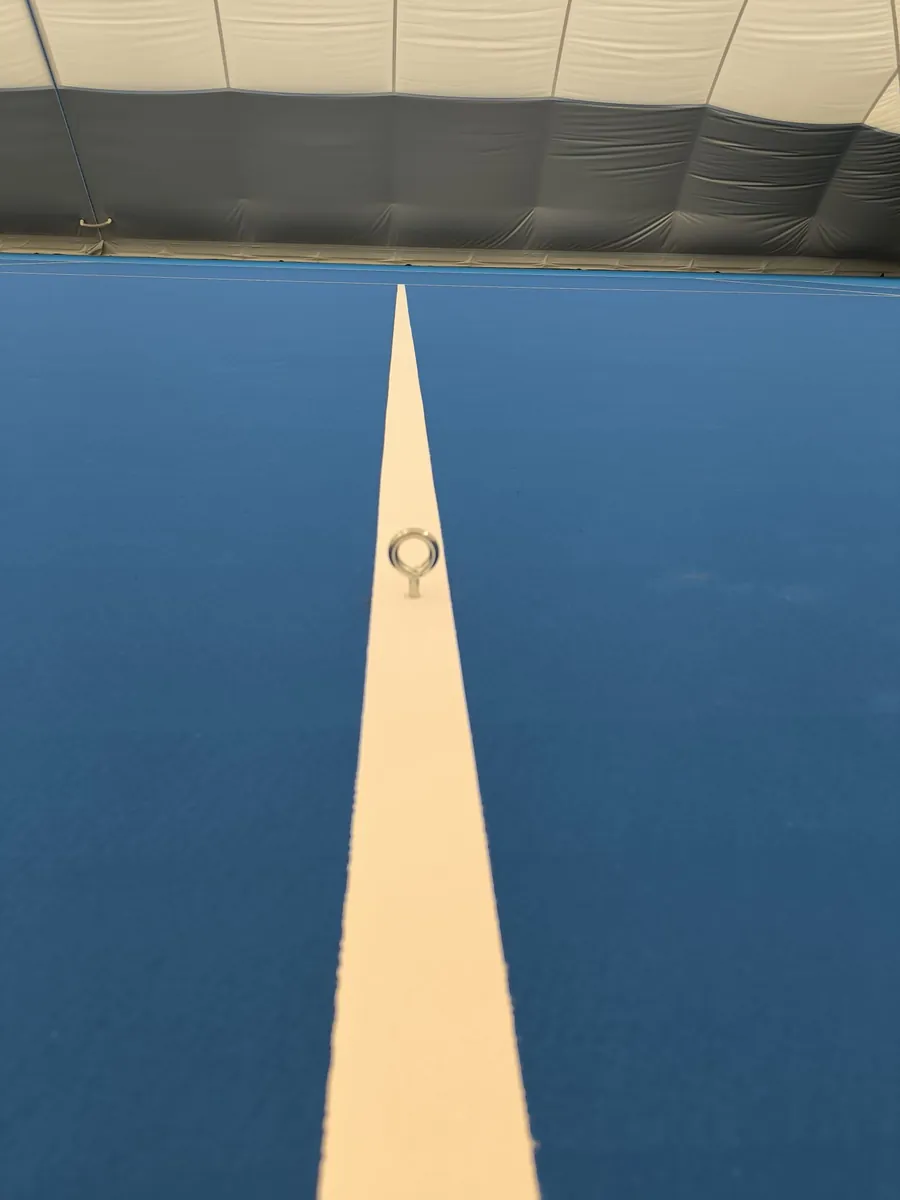
- Posts: three complete sets of tennis posts, installed.
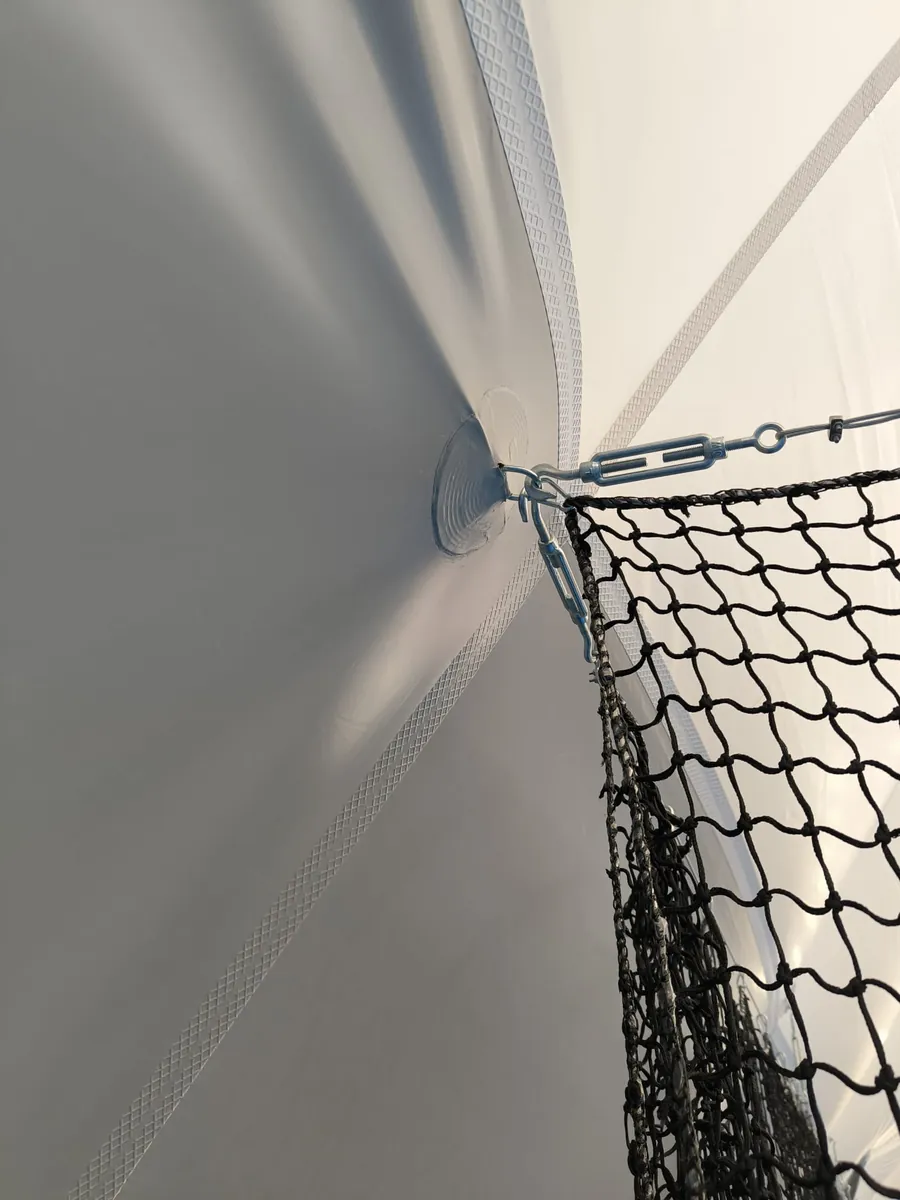
- Nets: black polyethylene, 42 mm mesh, 4 mm cord. The top edge is bound four times with polyester tape and tensioned with a 5 mm steel cable in PVC, 13.5 m long. The top six rows are doubled, so the net does not fray where the ball hits it most.
Posts and any other obstacles on the line where the membrane stands must be removable. This needs to be confirmed before the dome is installed.
What Other Clubs Can Take from This Project
- Treat the dome and the courts as one project. One supplier and one schedule leave no doubt about who is responsible for the interface between them.
- Lay the court layout down first. The dome size, the anchoring and the surface area all follow from it.
- Put the surface in after the dome. A heated dome turns weather-dependent surface work into a plannable job.
- Specify the asphalt base in advance. The surface supplier's specification should reach the asphalt contractor before the base is built.
- Choose a surface that suits the dome. A synthetic surface keeps the membrane and the perimeter clean and needs no watering.
If your club is weighing up a dome over existing courts mainly for winter play, the guide to covering a tennis court for winter compares the options.
Planning a Dome over Several Tennis Courts?
Send us the court layout, the plot plan and your intended operating season. CENTAURY+ will propose a dome size, the technical equipment and, if you need it, the court surface as one turnkey package.
Discuss Your ProjectFrequently Asked Questions
A full-size dome over three tennis courts is typically about 54 × 36 m. The dome in Lysá nad Labem measures 55.3 × 37 m with a height of 10 m, because the courts were laid out larger and the dome was resized to give players more space behind and beside the lines. The final size always follows the court layout, the plot boundaries and the space needed for anchoring, entrances and the plant room.
Yes. In Lysá nad Labem the surface was laid only after the dome was erected, working and able to be heated. Rain cannot stop the work, the base stays clean and dry, and the coatings cure at a stable temperature and humidity.
Synthetic hard or cushioned surfaces are the easiest to run under a dome because they produce no dust and need no watering. Clay is possible, but dust soils the membrane and can stop the inner membrane from sealing well at the perimeter, which means air leaks and higher heating use.
The ITF classifies court pace into five categories, from Category 1 (slow) to Category 5 (fast). Category 3 is a medium-paced surface: it suits club play, recreational players and junior training because rallies are neither too short nor too long.
In Lysá nad Labem the client's contractor built the asphalt base to a technical specification issued by CENTAURY+ in advance. Before the surface was applied, the asphalt was ground and primed. A flat, clean and fully cured base is what makes the finished surface even.
More completed projects are in our gallery.