
Every winter the same questions come from clubs, schools and towns that are thinking about an air dome: does it really stay warm when it freezes, how long before the first booking do you have to switch on the heating, and is it worth turning the heating down between sessions? The answers below come from measurements, not calculations: 38 million sensor readings from 12 of our domes in Slovakia, the Czech Republic and Austria, recorded from 19 December 2025 to 28 February 2026.
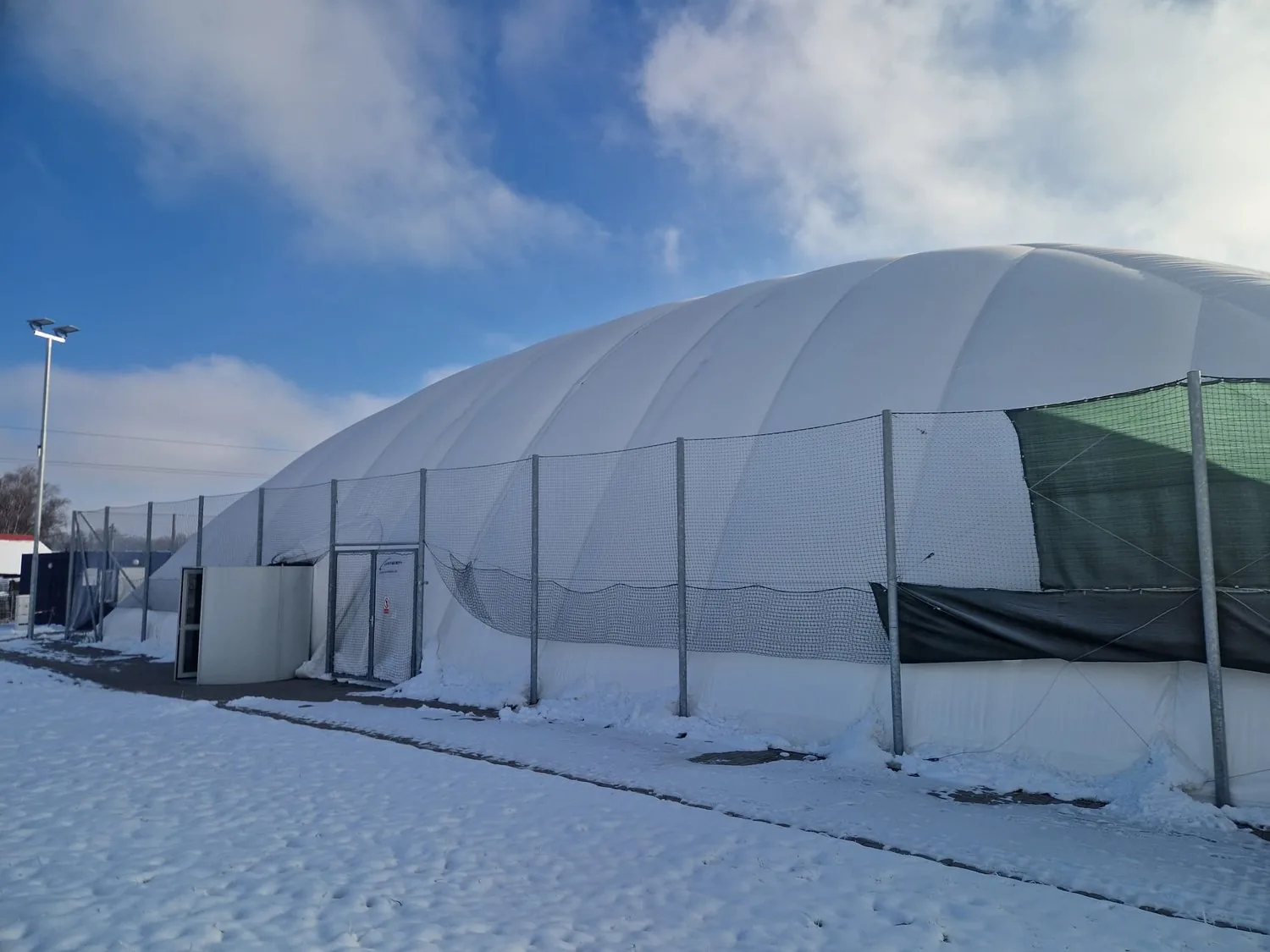
- Warm inside while it froze outside. We looked at 1,380 hours at playing temperature with frost outside in 10 sports domes. The typical indoor temperature was 13.4–18.8 °C, and after the warm-up the indoor air was within 2 °C of the setpoint in 97% of these hours. In Prešov, on the coldest evening the dome was heated for play, it was −9.6 °C outside and 13.1 °C inside.
- Fast warm-up. A typical warm-up took 29 minutes for a rise of about 11 °C, and 91% of all warm-ups were finished within an hour. In hard frost below −5 °C the typical warm-up took 48 minutes, so on the coldest mornings the heating goes on earlier.
- A real winter. The coldest reading was −17.0 °C outside, and two thirds of all dome-days (67%) had frost.
- Operators keep their domes at playing temperature only when they are used. 55% of the time the domes idled at a standby setpoint of 8 °C or lower, usually 0–6 °C.
- Standby cuts burner time: at −5 to 0 °C outside the burner ran 75% of the time at playing temperature but only 9% in standby.
- Each extra degree between indoor and outdoor air went with a median of 0.85 hours of burner running time per day.
The 12 domes and what they measure
Each CENTAURY+ dome reports its indoor and outdoor air temperature, the temperature setpoint and the operation of its heating to our remote monitoring system every few seconds. The 12 domes in this article, 11 sports domes and one dome over an outdoor swimming pool, are among the domes connected to this system. The domes differ in size, heating system and how they are used, so this is not a laboratory test. It is what happens in real domes, run by real operators, through a real winter.
| Domes | 12 CENTAURY+ air domes in Slovakia, the Czech Republic and Austria |
|---|---|
| Period | 19 December 2025 – 28 February 2026 (72 days) |
| Sensor readings analysed | 38.2 million |
| Dome-days analysed (full-day records) | 833 |
| Dome-days with frost | 561 (67%) |
| Dome-days at −10 °C or colder | 56 |
| Lowest outdoor temperature | −17.0 °C |
The domes stand in Nováky, Prešov, Košice, Nové Zámky and Leopoldov in Slovakia, in Planá, Mníšek pod Brdy, Brno-Bosonohy and Jihlava in the Czech Republic and in St. Valentin, Mauthausen and Vienna in Austria. In the charts and tables they are named after their location.
The domes are not heated all the time. At any given moment some of them are being heated and others are not heated at all, because nobody is playing, and the pool dome has no daily schedule. That is why some charts show fewer than 12 domes, and each chart says how many it includes.
How cold the winter got
The winter started mild and turned cold in two waves, in the first and the third week of January. On the coldest day across all domes, 12 January, the outdoor air averaged −5.5 °C over the whole day, and the burners ran an average of 10.6 hours per dome. On the mildest days at the end of February the average fell to 2.5 hours. The two curves below are close to mirror images: the correlation between the daily outdoor temperature and the daily burner running time is −0.91.
Outdoor temperature and burner running time, day by day
Daily averages across all domes reporting that day.
Blue: average outdoor temperature · Orange bars: average hours the burner ran per dome and day.
Warm inside while it freezes outside
What matters to players is the temperature once the dome is warm. We use the setpoint to find these hours: an hour at playing temperature is a clock hour in which the operator had the dome set to 12 °C or more, counted from two hours after the setpoint was raised. The warm-up itself has its own section below. In Prešov the coldest such hour came on 20 January at 21:00: −9.6 °C outside and 13.1 °C inside, with the dome set to 14 °C. In all 178 hours at playing temperature with frost outside, the indoor air in Prešov stayed within 2 °C of the setpoint.
The other sports domes show the same picture. Together they spent 1,380 hours at playing temperature with frost outside, in 10 of the 11 domes (the remaining one was not heated for play on any frosty day). While it froze outside, the typical indoor temperature was 13.4–18.8 °C, depending on how warm the operator set the dome. The indoor air swings a little around the setpoint as the burner switches on and off, so we count an hour as on target when it is within 2 °C of the setpoint. That was the case in 97% of the hours, in 4 domes in every single hour, and the indoor air was 12 °C or warmer in 99.5% of them.
Frost outside, warm inside: dome by dome
Median outdoor and indoor air during hours at playing temperature with frost outside. 10 sports domes, 1,380 hours.
Blue: outdoor air · Orange: indoor air · Hours: hours at playing temperature with frost outside in each dome.
How operators run a dome in winter
The domes in our data are not kept at one temperature day and night. The pattern is clear: the operator keeps the dome cool when it is empty and raises the setpoint for bookings. Across all 12 domes the setpoint was 8 °C or lower 55% of the time and 12 °C or higher 35% of the time. A typical standby setpoint was 0–6 °C and a typical playing setpoint 14–20 °C. Most domes changed the setpoint two to four times a day.
The daily rhythm is easy to read. In the 11 sports domes, which all follow a daily schedule, almost none is warm between 22:00 and 05:00. On weekdays the share of domes at playing temperature climbs from 07:00 and peaks at 84% at 17:00, when schools and clubs train after work. At weekends the peak comes in the morning, 70% at 10:00, and the evening is quieter.
When domes are warm: hour by hour
Share of time the domes were set to playing temperature (12 °C or higher), by hour of the day.
Orange: Monday to Friday · Blue dashed: Saturday and Sunday.
How fast an air dome warms up
Keeping a dome at 3 °C overnight only makes sense if it can be warm in time for the first booking. We timed 766 warm-ups in 12 domes: every time the setpoint was raised by at least 5 °C and then left unchanged, we measured how long it took until the indoor air was within 1 °C of the new setpoint. The typical warm-up went from about 3–5 °C to 15–16 °C, a rise of 11 °C.
- The median warm-up took 29 minutes.
- 91% of warm-ups took an hour or less and 96% took 90 minutes or less.
- The colder it is outside, the longer it takes: a median of 48 minutes below −5 °C, 34 minutes at −5 to 0 °C, 25 minutes at 0 to 5 °C and 20 minutes above 5 °C.
Here is one warm-up from close up, again in Prešov but on a different day than the evening above. On the morning of 9 January 2026 it was also −9.6 °C outside and the dome was idling at 1.7 °C. At 06:27 the setpoint was raised to 14 °C. The air-handling unit started blowing in air at about 55 °C, and within half an hour the indoor air had gained more than 9 °C. After 49 minutes it was at 13 °C. The burner did most of this on its lower stage.
One warm-up in Prešov, 9 January 2026
Minute-by-minute record from the Prešov dome at −9.6 °C outside. Zero is the moment the setpoint was raised.
Orange: indoor air · Blue: outdoor air · Purple dashed: setpoint · Shaded: setpoint at 14 °C.
Warm-up time by outdoor temperature
Median minutes until the indoor air was within 1 °C of a setpoint raised by at least 5 °C. The whiskers show the middle half of all warm-ups.
Bars: median warm-up time · Whiskers: 25th to 75th percentile.
How long the 766 warm-ups took
Share of warm-ups by the time needed to come within 1 °C of the new setpoint.
Orange: up to one hour · Grey: longer than one hour.
What this means in practice: most warm-ups are done within an hour, even in frost. The colder it is outside, the earlier the heating should go on: a lead time that is enough in mild weather is not enough on the coldest mornings. Use these times as a starting point and adjust them to your own dome; its size, heating output and standby setpoint all change how long it takes.
How much less the burner runs in standby
How much shorter does the burner run when the dome is in standby? To answer this without mixing domes of different size and heating, we compared each dome with itself: the share of each hour its burner ran in standby and at playing temperature, at the same outdoor temperature. The chart shows the median across the domes that spent at least 20 hours in both modes in each temperature band.
Burner running time per hour: playing temperature against standby
Median share of each hour the burner ran, comparing every dome with itself at the same outdoor temperature.
Orange: playing temperature (14 °C or higher) · Blue: standby (8 °C or lower). Domes compared: 6 at −10 to −5 °C, 10 at −5 to 0 °C, 11 at 0 to 5 °C, 10 at 5 to 10 °C.
Running time is not the same as energy. We measured how long the burner was on, not how much fuel it burned. Most of the burners have two output stages, and a long running time often means the lower one: at −10 to −5 °C, in 7 of the 10 sports domes with a two-stage burner, between 45% and 85% of the running time at playing temperature was on the lower stage. A dome in standby also has to be warmed up again before the next booking, which this hourly comparison leaves out. So the chart shows a measured difference in burner running time, not a saving in energy or cost.
Above freezing a dome in standby hardly needs heat at all: at 0 to 5 °C outside the burner ran 0.2% of the time against 64% at playing temperature. Even at −10 to −5 °C standby cut the burner running time from 91% to 29% of the hour. Put simply, between −10 and +5 °C the burner ran about 37–40 minutes less in an hour of standby than in an hour at playing temperature. That is the gap between the two bars: at −5 to 0 °C, for example, (75% − 9%) × 60 minutes = 40 minutes.
One exception: snow. Standby is for dry winter weather. When snow is falling, the operator follows the snow procedure for the dome, whatever the booking schedule says. In our domes this includes raising the heating setpoint to at least 15 °C, so the snow loosens where it touches the membrane and slides off. The full procedure is in our guide on removing snow from an air dome.

Heating time rises with the temperature difference
The last pattern is the most predictable one. When we plot each dome-day's average difference between indoor and outdoor air against the hours the burner ran that day, the points line up. In 10 of 12 domes the correlation is 0.9 or higher. A median dome needed 0.85 more hours of burner running time per day for every 1 °C of extra difference; across the domes the figure ranged from 0.65 to 1.19 hours, depending on size, membrane and burner output.
Daily burner running time against the indoor-outdoor difference
One dot for each dome and day (833 dome-days, 12 domes). The orange line connects the medians in 5 °C steps.
Blue dots: individual dome-days · Orange: median per band.
Read the other way round: in our domes, each 1 °C less of average indoor-outdoor difference went with about 50 minutes less burner time per day. This is the median relationship across the monitored domes, not a guaranteed result for every dome, and as shown above it varies from dome to dome. How much heat a given dome loses per degree depends on its size, membrane and air handling; we measured the heat loss of five domes in air dome U-value and heating costs.
The pool dome: a whole season of data
Nováky covers an outdoor swimming pool and is run differently from the sports domes. For most of the winter it was held at 10 °C, with a few short raises to 13–15 °C on single days, and from 28 February at pool temperature, 22–28 °C. On its coldest day, 9 January 2026, with −17.0 °C outside, the indoor air held hourly averages of 9.4–10.1 °C all day against the 10 °C setpoint.
In this dome the setpoint mattered more for heating hours than the frost. In January, with the deepest frost but a 10 °C setpoint, the heating ran 155 hours. In March, just after the period covered by this article, a much milder month but with the dome at pool temperature, it ran 376 hours; this figure comes from the dome's full-season record. The whole season of this dome, with charts and an hour-by-hour look at one late-winter day, is in our swimming pool air dome case study.
What this means if you run or plan a dome
- Heat for the booking, not for the calendar. In our domes a typical warm-up took about half an hour, and the burner ran far less in standby than at playing temperature.
- Plan the warm-up around the weather. Usually an hour is enough: 91% of the warm-ups in our domes were finished within an hour. On the coldest mornings switch the heating on earlier, and adjust the lead time to your own dome.
- Every degree counts. In our domes, each 1 °C of average difference between indoor and outdoor air went with about 50 minutes of burner time per day. This is the median relationship we observed, not a guaranteed saving for every dome.
- Heat when it snows. In snowfall the operator follows the snow procedure for the dome, even outside bookings. See how to remove snow from an air dome.
- Choose the heating with the site in mind. Whether it covers tennis courts, a football pitch or a basketball court, burner output, fuel and control are part of every air dome heating design. If you only want to play tennis through the winter, see how to cover a tennis court for winter.
- Know your costs before you decide. The price of the dome and the expected heating costs for your site are part of our free quote.
Common concerns about air domes in winter
Buyers who see the temperature data usually ask the same few questions next. Here are the short answers.
- Heavy snow. A dome is not built to carry a thick layer of snow. It is built so the snow does not stay on it: the control system raises the inside pressure, the operator raises the heating and the snow slides off the warm membrane. The design snow load is 30 kg/m² at 300 Pa. What to do in heavier snowfall is in our guide on removing snow from an air dome.
- Power cuts. Every CENTAURY+ dome comes with a diesel backup generator as standard. If the grid fails, it keeps the fans running and the dome stays up.
- Frost and the membrane. The membrane is rated from −30 °C to +70 °C, so the coldest night in our data (−17.0 °C) was well within its range. It meets fire class B-s2,d0 under EN 13501-1, and depending on the membrane type its service life is 20 or 30 years.
- Who watches the dome at night. Our own control system monitors pressure and temperature all the time and sends alerts by SMS and in the app. The operator sets the heating schedule remotely. The data in this article come from this system.
- When to heat outside bookings. In dry weather a low standby setpoint is enough. In snowfall the dome is heated whatever the booking schedule says.
- Running costs. Heating costs depend on the site, the fuel and how the dome is used. We calculate them for your site as part of the free quote.
For one of these domes in detail, see our case study of the tennis dome in Mauthausen, Austria, which covers four clay courts every winter.
Dome by dome
For readers who want to compare: the lowest outdoor temperature at each dome, the share of the monitored period spent in standby and at playing temperature, and how much the daily burner time grew per 1 °C of indoor-outdoor difference.
| Dome | Lowest outdoor | Time in standby (≤ 8 °C) | Time at playing temperature (≥ 12 °C) | Extra burner time per +1 °C |
|---|---|---|---|---|
| Nováky | −17.0 °C | 0% | 3% | 0.65 h |
| Planá | −15.0 °C | 66% | 34% | 0.98 h |
| Košice | −14.0 °C | 76% | 24% | 0.80 h |
| Prešov | −13.9 °C | 52% | 48% | 0.92 h |
| St. Valentin | −13.4 °C | 48% | 49% | 0.91 h |
| Mníšek pod Brdy | −11.5 °C | 66% | 34% | 0.76 h |
| Nové Zámky | −11.5 °C | 51% | 47% | 0.75 h |
| Mauthausen | −11.4 °C | 40% | 60% | 0.85 h |
| Leopoldov | −11.1 °C | 79% | 21% | 0.79 h |
| Brno-Bosonohy | −11.0 °C | 52% | 44% | 1.17 h |
| Vienna | −10.0 °C | 50% | 50% | 0.84 h |
| Jihlava | −9.4 °C | 84% | 9% | 1.19 h |
Nováky (the pool dome) was held mostly at 10 °C, between the two bands, and at pool temperature from 28 February. Extra burner time is in hours per day.
CENTAURY+ reference values for heating an air dome in winter
These values come from our own measurements in 12 domes, 19 December 2025 to 28 February 2026. Use them as a reference when you plan the heating schedule of an air dome. Journalists, students and other publishers are welcome to use them; please cite CENTAURY+ air dome monitoring data, winter 2025/26 and link to this page.
| Value | Measured |
|---|---|
| Typical warm-up (rise of about 11 °C) | 29 minutes |
| Warm-up below −5 °C outside | 48 minutes |
| Warm-up above +5 °C outside | 20 minutes |
| Warm-ups finished within an hour | 91% |
| Typical indoor temperature at playing temperature with frost outside | 13.4–18.8 °C, depending on the setpoint |
| Hours at playing temperature with frost outside within 2 °C of the setpoint, after warm-up | 97% of 1,380 hours in 10 sports domes |
| Typical standby setpoint | 0–6 °C |
| Typical playing setpoint | 14–20 °C |
| Burner running time at −5 to 0 °C outside | 75% of the hour at playing temperature, 9% in standby |
| Shorter burner running time per hour in standby (−10 to +5 °C) | about 37–40 minutes |
| Extra burner time per +1 °C indoor-outdoor difference | 0.85 hours a day |
Measurement method
The CENTAURY+ remote monitoring system recorded the indoor and outdoor air temperature, the setpoint and the operation of the heating in 12 domes every few seconds from 19 December 2025 to 28 February 2026. Dome-days are counted when a dome reported the full day. A warm-up is every rise of the setpoint by at least 5 °C that was left unchanged until the indoor air came within 1 °C of the new setpoint, timed until that moment. Standby means a setpoint of 8 °C or lower, playing temperature 12 °C or higher (14 °C or higher in the burner comparison), and burner running time is the time the heating was switched on, not the energy it used. Hours at playing temperature are defined by the setpoint, not by booking records: clock hours with the setpoint at 12 °C or higher, counted from two hours after the setpoint was raised, whether or not the dome had reached it, with at least 45 minutes of data.
Sources
- CENTAURY+ air dome monitoring data, winter 2025/26, 12 domes in Slovakia, the Czech Republic and Austria.
- CENTAURY+ field measurement of membrane heat loss in five domes: air dome U-value and heating costs.
- CENTAURY+ season-long monitoring of a pool dome: swimming pool air dome case study.
Frequently asked questions
How warm does an air dome stay in winter?
In 1,380 hours at playing temperature with frost outside, in 10 sports domes, the typical indoor temperature was 13.4–18.8 °C, depending on the dome's setpoint. After the warm-up, the indoor air was within 2 °C of the setpoint in 97% of these hours and 12 °C or warmer in 99.5% of them.
How long does it take to heat an air dome?
In 766 warm-ups in 12 domes the median was 29 minutes for a rise of about 11 °C, typically from 3–5 °C to 15–16 °C, and 91% of all warm-ups were finished within an hour. The colder it is, the longer it takes: below −5 °C outside the median was 48 minutes, so on the coldest mornings the heating should be switched on earlier. The right lead time depends on the dome's size, heating output and standby setpoint.
Is it worth turning the heating down between sessions?
In our data the burner ran much less in standby. Comparing the same domes at the same outdoor temperature, it ran 75% of the hour at playing temperature but 9% in standby at −5 to 0 °C outside: about 37–40 minutes less burner time per hour between −10 and +5 °C. This is running time, not energy, and the warm-up before the next booking is not included.
Should a dome be kept in standby when it snows?
No. Standby is for dry winter weather. When snow is falling, the operator follows the snow procedure for the dome, whatever the booking schedule says. In our domes this includes raising the heating setpoint to at least 15 °C, so the snow can slide off the membrane.
How much longer does the heating run when it gets colder?
In 12 domes the daily burner running time rose almost linearly with the difference between indoor and outdoor air: by a median of 0.85 hours a day for every 1 °C of extra difference. The figure differs from dome to dome.
Get a free quote for your air dome
This article shows how our domes run in winter. Your own project raises its own questions. Ask us for a free, no-obligation quote and we will answer them for your site:
- what a dome for your court or pitch will cost,
- what heating and running costs to expect for your location, size and playing schedule,
- which heating, fuel and burner output suit your climate,
- which indoor temperature fits your use, from tennis and football to school sport,
- how remote monitoring and the heating schedule will be set up for your dome,
- references from domes similar to yours.
Tell us the sport, the size of the court or pitch, the location and how many hours a week you expect to play.
Want to see prices first? A turnkey CENTAURY+ dome over one tennis court (36 × 18 m) costs EUR 100,000–150,000, excluding VAT. Prices for all other sizes are in the full price list, which we send to your email.
Indicative Price List
| Dimensions (m) | Area (m²) | Price from | Price to | Avg. price/m² |
|---|---|---|---|---|
| 36×18 | 648 | €100k | €150k | 193 € |
| 25×40 | 1 000 | |||
| 36×36 | 1 296 | |||
| 54×36 | 1 944 | |||
| 72×36 | 2 592 | |||
| 40×70 | 2 800 | |||
| 115×80 | 9 200 |
Get the full price list by email
All 7 hall sizes from 648 m² to 9,200 m², with price ranges and average price per m².
* k = thousand; prices exclude VAT. Average price per m² calculated from midpoint.