

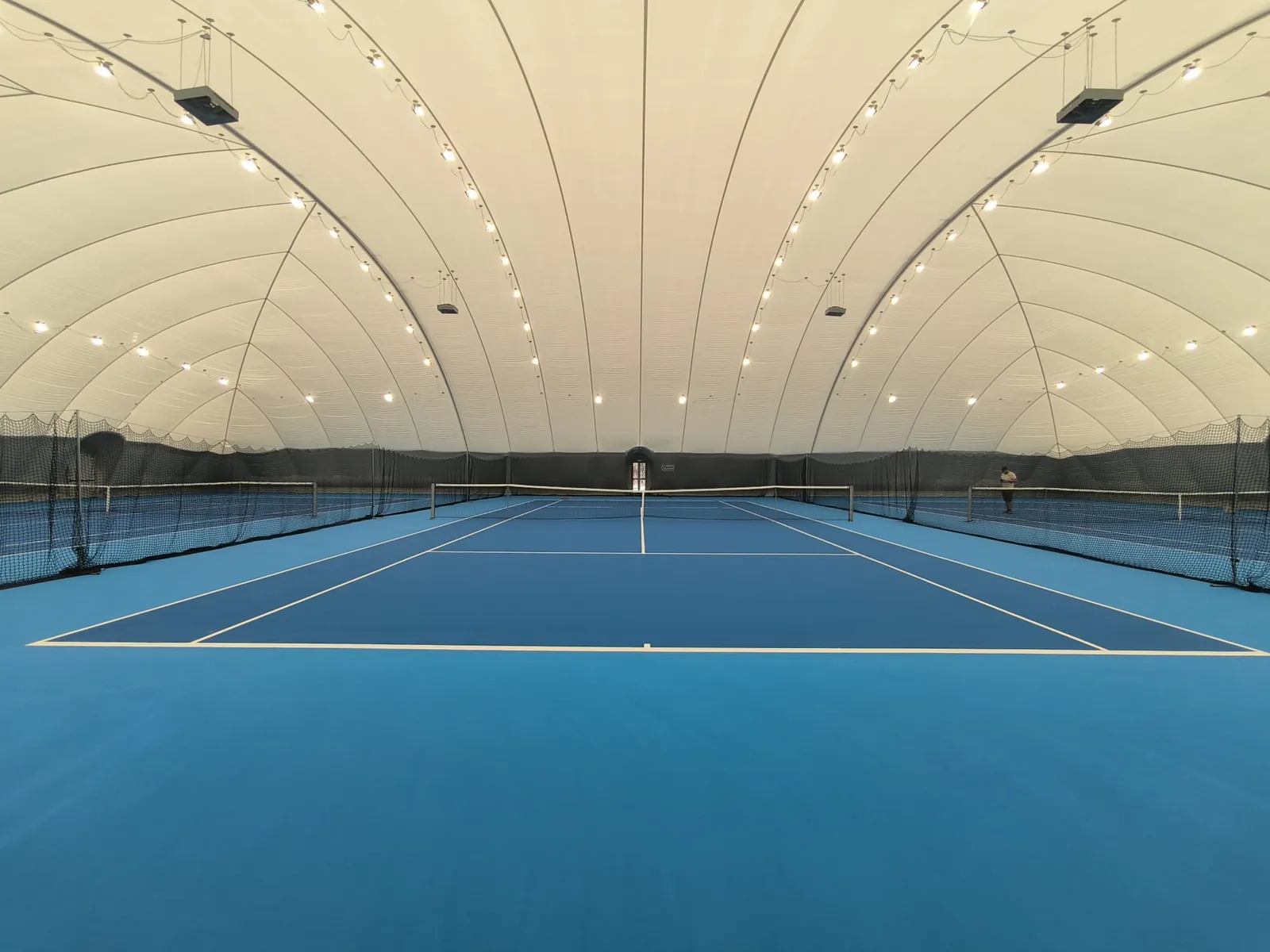
In Mauthausen, Upper Austria, a CENTAURY+ air dome covers four clay tennis courts of the Danubis tennis centre every winter. The dome measures 62 × 36 × 10 m and was delivered in 2021 to the club Union Mauthausen, Austrian team champion in 2020, 2024 and 2026. It stands from late September to April, so the club's members and players can use the courts all year round. In spring the dome comes down and the courts are outdoor courts again.
We monitor the dome remotely, so we know exactly how it performed last winter. Between 19 December 2025 and 28 February 2026, the indoor air stayed within 1 °C of the 15 °C playing temperature in 99% of 827 playing hours, and the median warm-up from standby took 33 minutes.
If your club is thinking about winter tennis on its own courts, this article shows what it can expect: what the dome gave the club, how it is built, how it performed in frost, and how a project with CENTAURY+ runs.
Table of Contents
- Project at a Glance
- What the Dome Gives the Club
- The Club and the Years Since 2021
- A Seasonal Dome Over Clay Courts
- Four Courts in 62 × 36 m
- The Dome and Its Technology
- Safe in Wind, Snow and Power Cuts
- Heating a Dome in Austria
- Anchoring and Site Preparation
- How Warm It Was Last Winter
- Clay Under a Dome: What Changes
- Air Dome or Permanent Tennis Hall?
- Why Clubs Choose CENTAURY+
- How a Project With Us Runs
- More of Our Recent Tennis Domes
- Frequently Asked Questions
- Get a Free Quote for Your Tennis Dome
Project at a Glance
| Location | Danubis tennis centre, Mauthausen, Upper Austria |
|---|---|
| Client | Union Mauthausen Hallentennis (tennis club) |
| Use | Four clay tennis courts, seasonal operation from late September to April |
| Delivered | 2021 |
| Scope | Air dome with all technology, delivery and installation |
| Dome size | 62 × 36 m, height 10 m |
| Membrane | Double-layer membrane, about 3,450 m², design U-value 1.9–2.0 W/m²K |
| Anchoring | 132 ground anchors and 27 concrete anchors |
| Air and heating | Air-handling unit with hot-water heating (glycol circuit) |
| Warm air at court level | 8 destratification fans |
| Lighting | 72 LED luminaires |
| Plant room | In a container next to the dome |
| Operation | Operating manual in the club's language, SMS alerts, remote monitoring |
What the Dome Gives the Club
The dome turns four outdoor courts into indoor courts for the whole winter. Without it, these four courts would stand unused from autumn to spring. With it, the club can offer them every day of the winter season, in any weather.
- More than 11,000 bookable court hours per season. In the 2026/27 season the four courts under the dome can be booked from 8:00 to 22:00 for 203 days, from 21 September to 11 April. That is 4 courts × 14 hours × 203 days, or about 11,400 court hours that the club can sell to members, guests and its academy.
- Clay all year. Players train in winter on the same surface they play on in summer.
- Comfortable play in frost. On the coldest evening of play last winter it was −7 °C outside and 14.3 °C on the courts.
- Heat only when someone plays. When nobody is playing, the dome waits at 3 °C and is warm again in about half an hour.
- Summer stays summer. In spring the dome comes down and the courts are outdoor courts again. The centre's clay courts also host an ATP Challenger tournament, played outdoors once the dome is down.
The Club and the Years Since 2021
Union Mauthausen is one of Austria's strongest tennis clubs: its team won the Austrian championship in 2020, 2024 and 2026. The club plays at the Danubis tennis centre in Mauthausen, on the Danube east of Linz, which has outdoor clay courts and its own tennis academy.
The club wanted to use its courts in winter as well, not only from spring to autumn. The brief was a dome over four clay courts that goes up in autumn, keeps the courts warm and lit all winter and comes down again in spring.
- 2021: CENTAURY+ delivers the dome. Training at the new centre starts at the end of 2021.
- Spring 2022: The dome comes down and makes way for the stands of the ATP Challenger tournament. The centre is officially opened on 31 March 2022.
- Every season since: The dome goes up in late September and comes down in April.
- Winter 2025/26: We analyse a full winter of remote-monitoring data from the dome. The results are further below.
- Season 2026/27: The four courts under the dome are bookable from 21 September 2026 to 11 April 2027, from 8:00 to 22:00.
A Seasonal Dome Over Clay Courts
A seasonal dome gives a club winter tennis without a permanent building on its courts. Members and juniors train on clay in winter too, and in summer the courts are open again. The dome goes up much faster than a permanent building and, unlike a building, can be taken down again, so the club decides each year how long the winter season runs.
Clubs that do not want to take the dome down and put it up again themselves can leave this to us: CENTAURY+ offers seasonal dismantling and reassembly for the domes it has installed. If you are only starting to compare options for winter play, the guide to covering a tennis court for winter compares domes with other solutions.

Four Courts in 62 × 36 m
The Mauthausen dome covers four clay courts side by side in a footprint of 62 × 36 m, with a ridge height of 10 m. All four courts are under one membrane, so one air and heating unit, one plant room and one control system serve the whole dome.

The size of a dome is never taken from a catalogue. The club chooses it, and we advise on the court layout, the run-offs, the plot and the space needed outside the courts for the anchoring, the entrances and the plant room. The recommended run-offs per court are listed in the indoor tennis court dimensions table.
The Dome and Its Technology
The main parts of the dome at a glance, with what each of them does:
| Component | Key parameters | What it does |
|---|---|---|
| Double-layer membrane | About 3,450 m², air gap about 300 mm, design U-value 1.9–2.0 W/m²K, effective U-value from our field test 1.72 W/m²K | Encloses and insulates the dome; up to 30% lower heating costs than a single layer |
| Air-handling unit | Fans and a heat exchanger with hot water from a glycol circuit | Keeps the dome inflated and heats it |
| Destratification fans | 8 fans under the roof | Bring warm air from under the roof down to the courts |
| LED lighting | 72 luminaires | Lights the four courts |
| Plant room | Container next to the dome | Houses the air-handling unit, so no plant-room building is needed |
| Control system | CENTAURY+ software, smartphone app, SMS control, alerts | Controls pressure, fans and heating together; remote monitoring |
| Diesel backup generator | Starts automatically when the mains power fails | Keeps the dome inflated in a power cut |
| Anchoring | 132 ground anchors and 27 concrete anchors | Holds the dome firmly to the ground |
Double-Layer Membrane
The dome has a double-layer membrane with an area of about 3,450 m². The air gap of about 300 mm between the two layers insulates the dome and can cut heating costs by up to 30% compared with a single-layer membrane. The design U-value is 1.9–2.0 W/m²K. In operation, the Mauthausen dome reached an effective U-value of 1.72 W/m²K, the best of the five domes we have tested this way. We derived it from a cooling test: at night, with the heating off and the fans running normally, we measured how fast the indoor air cooled and related that heat loss to the dome's surface area and the difference between indoor and outdoor temperature. It is a field estimate for the whole dome, not a certified value of the membrane. The method and what it means for heating costs are explained in the air dome U-value and heating-cost guide.
Air Handling and Heating
Air and heat come from one air-handling unit. Its fans keep the dome inflated, and a heat exchanger warms the air with hot water from a glycol circuit. Because the same unit inflates and heats the dome, the pressure regulation and the heating are controlled together.
Warm Air Where the Players Are
Warm air rises. Under a 10 m high roof, it would collect at the top while the players are cold. Eight destratification fans push the warm air from under the roof back down to the courts, so the heat stays where it is needed.
Lighting
The courts are lit by 72 LED luminaires. In daytime the translucent membrane also lets natural light into the dome.
Plant Room in a Container
The air-handling unit sits in a container next to the dome. The club did not have to build a plant room for it: the container is delivered ready, placed on site and connected to electricity and the heating circuit.
Our Own Control System
The dome is run by a CENTAURY+ control system with our own software. One industrial controller reads all the sensors and controls the fans, the pressure and the heating together. The club's staff can watch and control the dome from a smartphone app, by SMS when there is no internet, and get alerts straight away if something needs attention. We see the same data, so we can help remotely, and we keep updating the control software for years after delivery.
Safe in Wind, Snow and Power Cuts
Wind, snow and power cuts are handled automatically by the control system and the backup generator. Every CENTAURY+ dome comes with the following as standard:
- Automatic wind protection. The control system measures the wind speed and raises the inside pressure automatically.
- Diesel backup generator. If the mains power fails or the main air unit stops, the backup starts automatically and keeps the dome inflated.
- Overpressure protection. If the pressure rises above the safe limit, the control system releases air automatically.
- Certified membrane. Fire classification B-s2,d0 to EN 13501-1. The membrane material is rated for temperatures from −30 to +70 °C, and our structures comply with EN 13782 for temporary structures.
The wind and snow loads are designed for each site. In Mauthausen the dome normally runs at about 175 Pa and goes to 200 Pa above about 40 km/h of wind and to 300 Pa above about 100 km/h. At 300 Pa it is designed for a snow load of 30 kg/m². Warm air under the curved membrane melts the snow from below and lets it slide off; our guide on removing snow from an air dome describes the full procedure.
Heating a Dome in Austria
The dome has hot-water heating: the air-handling unit warms the air through a heat exchanger fed by a glycol circuit. Because the heat arrives as hot water, the heat source is separate from the dome itself and can be chosen to suit local rules and the energy available on site. Austria's Renewable Heat Act (EWG) restricts fossil-fuel heating in new buildings, so a new project should confirm with the authority how a seasonal dome is classified and which heating is allowed. Our article on heating air domes in Austria explains the options.
Anchoring and Site Preparation
The dome is held down by 132 ground anchors and 27 concrete anchors. Which type of anchor is used where depends on the ground and the structural calculation for the site.
Before the first installation, the site has to be ready: the anchors in place, electricity and the heating connection at the plant room, and nothing on the line where the membrane will stand. Once the foundations are ready, a CENTAURY+ tennis dome is erected within 5 days. What has to happen before installation day is described in the tennis dome buyer's guide.

How Warm It Was Last Winter
The control system records the indoor and outdoor temperature, the setpoint, the heating and the inflation pressure. The figures below cover 19 December 2025 to 28 February 2026. The club played at 15 °C and kept the dome at 3 °C when nobody was playing.
Playing Temperature, Also in Frost
By playing hours we mean the hours when the dome was set to the 15 °C playing temperature. They come from the control system, not from the booking records. We count them from two hours after each switch to 15 °C, so the warm-up is left out.
In 99% of the 827 playing hours the indoor air was within 1 °C of 15 °C, and within 2 °C in practically all of them. The median indoor temperature during play was 14.9 °C and the lowest hourly average 13.3 °C. In 155 of the playing hours it was freezing outside; even then the indoor air was within 2 °C of the setpoint in 99% of the hours.
One Frosty Day: 7–8 January 2026
Measured record from the Mauthausen dome, from the morning of 7 January to the next morning, which included the coldest evening of play and the coldest night of the winter.
Orange: indoor air · Blue: outdoor air · Purple dashed: setpoint · Shaded: dome set to 15 °C.
At 7:13 the club switched from standby to 15 °C, with −5 °C outside. Within an hour the courts were at 14 °C. Through the day and evening the indoor air stayed at 14–15 °C while it got colder outside: at 20:00 it was −7.0 °C outside and 14.3 °C inside. At 21:33 the dome went back to standby and held 3 °C through the night. At 1:54 it was −11.4 °C outside, the coldest moment of the winter, and 2.9 °C in the dome.
Warm-Up: About Half an Hour
In 69 warm-ups from standby, typically from about 4 °C, the dome reached 15 °C:
| Warm-up from standby to 15 °C | Time |
|---|---|
| Fastest | 17 minutes |
| Typical (median) | 33 minutes |
| 3 out of 4 warm-ups | 40 minutes or less |
| Longest | 82 minutes |
Warm-ups took place at outdoor temperatures down to −10.2 °C. On the coldest mornings it pays to switch the heating on earlier.
Standby When Nobody Plays
The club did not heat the dome around the clock. About 60% of the time the dome was at playing temperature and 40% in standby at 3 °C; on average the setpoint changed about twice a day.
The colder it gets, the longer the heating runs. In Mauthausen, every extra degree between indoor and outdoor air added about 0.85 hours of heating time per day.
Stable Inflation Pressure
The dome is held up by a slight overpressure. The target was 175 Pa; the typical value was 172.5 Pa, and the pressure stayed within 10 Pa of the target 97% of the time.
Measured winter data from another CENTAURY+ dome, over a swimming pool, are in our article on winter data from a CENTAURY+ pool dome.
Want to know how a dome would perform at your club? Tell us your courts, your location and the months you want to play. With your free quote you get the price and an estimate of the heating and running costs.
Request a free quoteClay Under a Dome: What Changes
Clay courts can be played under an air dome, but they need more care than a synthetic surface. This is what a club should plan for:
- Moisture. Clay has to stay slightly moist to play well. Under a dome there is no rain, so the courts need watering.
- Ventilation. Heated air dries the clay, and too much moisture leads to condensation on the membrane. The ventilation and heating are set to avoid both.
- Dust. Dry clay produces dust that settles on the membrane. Keeping the courts moist helps here too.
- The perimeter. On clay, the inner membrane does not seal as well at the edge, which means air leaks and higher heating use. PE sheeting is laid under the membrane at the perimeter.
A synthetic surface avoids most of this, as the comparison in our Lysá nad Labem case study shows. But where the members want clay, a dome over clay courts is a proven solution, and Mauthausen shows that it works through a whole Austrian winter.
Air Dome or Permanent Tennis Hall?
For a club with outdoor courts, a seasonal air dome is usually the faster and cheaper way to winter tennis than a permanent hall. This is how they compare:
| Seasonal air dome | Permanent tennis hall | |
|---|---|---|
| Courts in summer | Outdoor courts again after the dome comes down | Indoor courts all year |
| Surface | The club keeps its surface, also clay | Chosen for the hall |
| Price | EUR 100,000–150,000 for one court, turnkey, excluding VAT | Usually much higher |
| Time on site | Erected within 5 days once the foundations are ready | Months of construction |
| Daylight | Translucent membrane lets daylight in | Depends on the design |
| Heating | Our control system keeps the dome at standby when nobody is playing and warms it up in about half an hour | Depends on the building and its heating system |
| Approvals | Needed; a seasonal dome is not automatically exempt | Full building permit |
A permanent hall makes sense where a club wants indoor courts all year and has the budget and the time to build. Where a club wants to keep its outdoor courts and play on them in winter too, a dome like the one in Mauthausen is the simpler solution.
Why Clubs Choose CENTAURY+
CENTAURY+ has built more than 100 air domes. We design, make and deliver the dome together with all its technology, and we stay with the club after delivery. This is what clubs get from us:
Proof, not promises
The winter data above come from the dome's own remote monitoring: in 99% of 827 playing hours the air stayed within 1 °C of 15 °C, and the effective U-value from our cooling test is 1.72 W/m²K. Ask us for the measured figures from our other domes.
Lower heating costs
A double-layer membrane is standard on every dome and can cut heating costs by up to 30% compared with a single layer.
Everything in one price
The turnkey price includes the membrane, foundation, anchoring, air handling and pressure control, diesel backup, heating, LED lighting and assembly. VAT, earthworks, utility connections, permits and the court surface are quoted separately.
Fast on site
Once the foundations are ready, a tennis dome is erected within 5 days. Your courts are not a building site for months.
Long life and a clear warranty
Standard membranes are specified for around 20 years, premium Low Wick membranes for around 30 years. The warranty is 5 years on the standard membrane, typically 10 years or more on Low Wick, and 2 years on the other components.
Our own control system
Our own software, a smartphone app, SMS control and automatic alerts. We see the data too, so most questions can be solved remotely.
Made to measure
Every dome is made for its site: 62 × 36 m over four courts in Mauthausen, 55.3 × 37 m over three courts in Lysá nad Labem. You decide the size, the courts it covers and where the entrances go, and we advise you on the options.
Support for years
We offer seasonal dismantling and reassembly and stay available to the club long after delivery. CENTAURY+ is ISO 9001:2015 certified.
How a Project With Us Runs
- Free quote. You tell us the number of courts, the location and the months you want to play. We send you the price and an estimate of the running costs.
- Your dome, made to measure. You choose the exact size and shape of the dome, the courts it covers, the entrances and the place for the plant room. We advise you on what works best for your site.
- Production. The membrane and the technology are made for your dome.
- Site preparation. The foundations or anchors are made, and electricity and the heating connection are brought to the plant room.
- Installation and commissioning. The dome is erected, and the pressure, heating, lighting and backup are set and tested.
- Handover. The club gets the operating manual in the language it chooses and access to the app, and can start playing.
- Every season after. We watch the dome with you, help remotely and, if you wish, take care of dismantling in spring and reassembly in autumn.
More of Our Recent Tennis Domes
Mauthausen is one of many CENTAURY+ domes over tennis courts. Here are a few examples of the newer tennis domes we have built:
- Three-court tennis dome in Lysá nad Labem, Czech Republic. A 55.3 × 37 m dome where the court surface was laid under the finished dome, with the dome and the surface from one supplier.
- Multi-sport dome in Leopoldov, Slovakia. One court marked for tennis, basketball and volleyball, handed over in 2023. Its effective U-value of 1.80 W/m²K is also one of the best among our domes.
- Tennis dome in Kaunas, Lithuania. Watch the video of its construction in our tennis dome buyer's guide.
More completed projects are in our gallery.
Frequently Asked Questions
Yes. In Mauthausen, Upper Austria, a CENTAURY+ air dome covers four clay courts at the Danubis tennis centre every winter, from late September to April. The clay needs more care under a dome than a synthetic surface: it has to be kept moist, dust settles on the membrane, and the ventilation has to avoid both drying the courts and condensation.
In the Mauthausen dome, set to 15 °C for play, the indoor air stayed within 1 °C of the setpoint in 99% of 827 playing hours between 19 December 2025 and 28 February 2026. Playing hours are the hours the dome was set to 15 °C, counted from two hours after each switch to 15 °C. On the coldest playing evening it was −7.0 °C outside and 14.3 °C inside. The median warm-up from standby at about 4 °C to 15 °C took 33 minutes; three quarters of the 69 warm-ups took 40 minutes or less. The dome is 62 × 36 × 10 m and has hot-water heating.
The Mauthausen dome covers four tennis courts with a footprint of 62 × 36 m and a height of 10 m. The final size of any dome follows the court layout, the run-offs the club wants and the space needed for anchoring, entrances and the plant room.
Usually yes. A turnkey CENTAURY+ dome over one tennis court (36 × 18 m) costs EUR 100,000–150,000, excluding VAT. That includes the double-layer membrane, foundation, anchoring, air handling and pressure control, a diesel backup generator, heating, LED lighting and assembly. Once the foundations are ready, the dome is erected within 5 days, and a seasonal dome lets the courts stay outdoor courts in summer. Prices for larger domes are in our price list.
The control system measures the wind and raises the inside pressure automatically. In Mauthausen it goes to 200 Pa above about 40 km/h and to 300 Pa above about 100 km/h, and at 300 Pa the dome is designed for a snow load of 30 kg/m²; heating helps the snow slide off. The wind and snow loads are designed for each site. If the mains power fails, a diesel backup generator, included in every CENTAURY+ dome, starts automatically and keeps the dome inflated.
CENTAURY+ (airdomes.pro) designs and supplies air-supported tennis domes for clubs and towns in Austria, Germany and across Europe and has built more than 100 air domes. One example is the four-court dome of Union Mauthausen at the Danubis tennis centre in Upper Austria, delivered in 2021.
Get a Free Quote for Your Tennis Dome
Thinking about a dome over your own courts, clay or hard? Ask us for a free, no-obligation quote and we will answer the questions for your club:
- what a dome for your number of courts will cost,
- what size fits your courts and your plot,
- what heating and running costs to expect for your location and playing hours,
- which heating suits your country's rules and your climate,
- references from domes similar to yours.
Tell us the number of courts, the surface, the location and the months you want to play.
Want to see prices first? A turnkey CENTAURY+ dome over one tennis court (36 × 18 m) costs EUR 100,000–150,000, excluding VAT. Prices for all other sizes are in the full price list, which we send to your email.
Indicative Price List
| Dimensions (m) | Area (m²) | Price from | Price to | Avg. price/m² |
|---|---|---|---|---|
| 36×18 | 648 | €100k | €150k | 193 € |
| 25×40 | 1 000 | |||
| 36×36 | 1 296 | |||
| 54×36 | 1 944 | |||
| 72×36 | 2 592 | |||
| 40×70 | 2 800 | |||
| 115×80 | 9 200 |
Get the full price list by email
All 7 dome sizes from 648 m² to 9,200 m², with price ranges and average price per m².
* k = thousand; prices exclude VAT. Average price per m² calculated from midpoint.
Sources
- Danubis Tennis Mauthausen, club website.
- Danubis court booking: clay courts under the air dome, winter season 2026/27.
- MeinBezirk: opening of the new tennis centre in Mauthausen, 2022.