
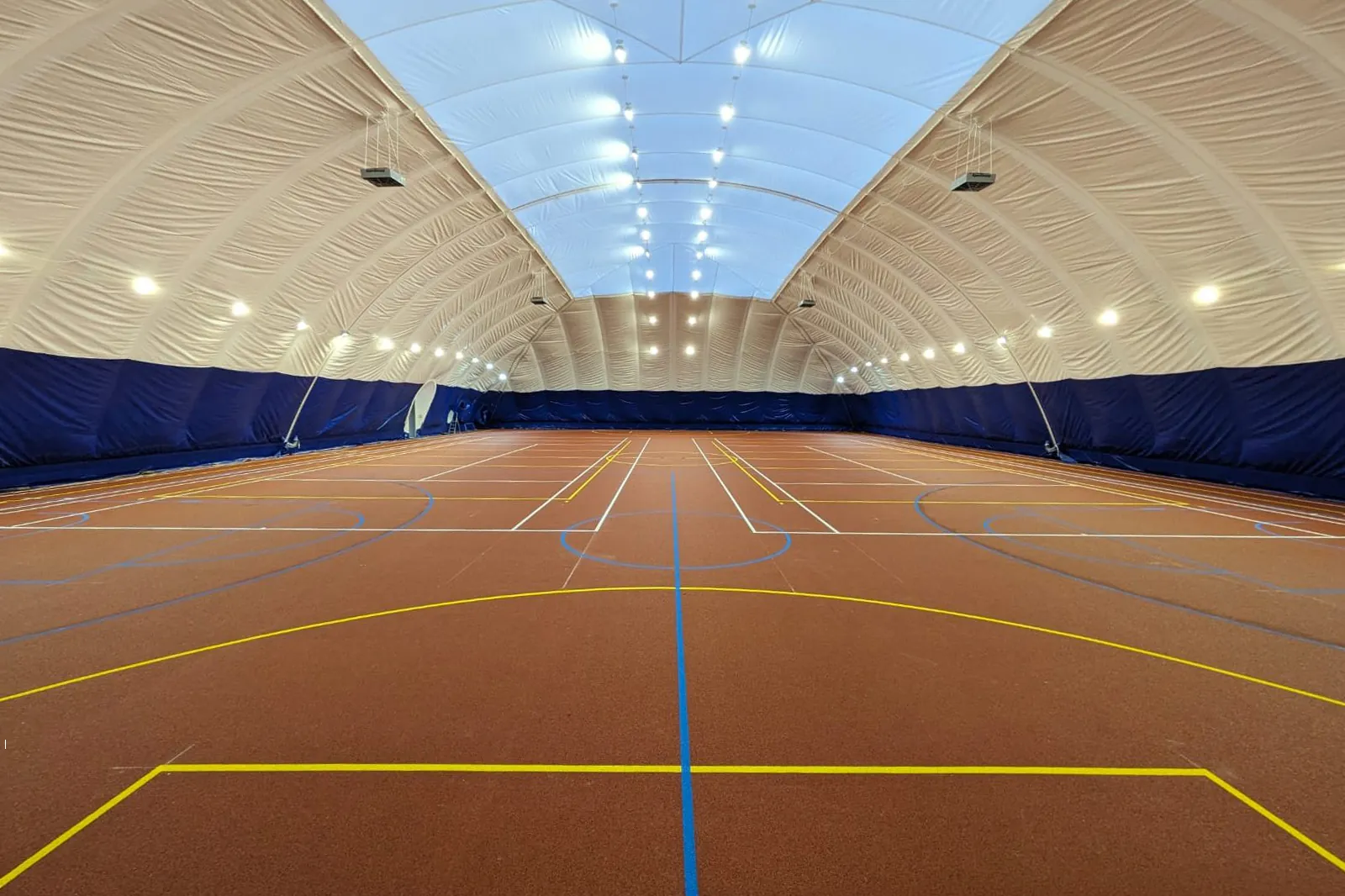
The 44 × 30 m multi-sport court under the CENTAURY+ dome in Leopoldov, Slovakia.
In Leopoldov, a small town in the Trnava Region of western Slovakia, a CENTAURY+ air dome covers the town's 44 × 30 m multi-sport court, and it is used for six sports: tennis, football, volleyball, futnet, basketball and running. The town owns the dome and runs it itself. It is open to the public every day from October to April, booked online by the hour, one court or the whole hall at a time.
The dome was handed over in 2023, and the town opened it to the public in October 2024. Our remote monitoring shows how it performed in its second winter: when a booking starts, the town raises the setpoint from frost protection to 16 °C, and the median warm-up took 22 minutes. During heated play the indoor air had a median of 15.8 °C, and on the coldest night, at −11.1 °C outside, the dome stood steady at its normal pressure.
If you are a town, a school or a sports club thinking about one covered court for several sports, this article shows what Leopoldov got: how the court is shared between sports, what is inside the dome, how warm it was in frost, and what a town should plan for to run it.
Table of Contents
- Project at a Glance
- What the Dome Gives the Town
- The Town, the Clubs and the Timeline
- Six Sports on One Court
- The Dome and Its Technology
- Safe in Wind, Snow and Power Cuts
- How Warm It Was in Winter
- What a Town Should Plan For
- Why Towns Choose CENTAURY+
- How a Project With Us Runs
- More of Our Domes
- Frequently Asked Questions
- Get a Free Quote for Your Multi-Sport Dome
Project at a Glance
| Location | Town sports grounds (MTK Leopoldov), Gucmanova 13, 920 41 Leopoldov, Trnava Region, Slovakia |
|---|---|
| Owner and operator | Town of Leopoldov |
| Use | Multi-sport court: two tennis courts, football, volleyball, futnet, basketball and a running track |
| Handover and operation | Handed over in 2023; open to the public since October 2024, from October to April, daily 10:00–21:00 |
| Size | Covers the whole 44 × 30 m playing area; height 10 m |
| Membrane | Outer Low Wick PVC-coated polyester membrane (900 g/m²), an inner membrane and a double-sided reflective insulating foil between them; translucent 21 × 12 m section in the middle of the roof; fire class B-s2,d0 to EN 13501-1 |
| Anchoring | Ground anchors, each made of eight 16 mm steel bars, pull-tested to at least 25 kN |
| Surface | 10 mm water-permeable EPDM sports surface (CONIPUR EPDM) with lines for several sports |
| Air handling and heating | CMT GP 375 warm-air unit with a two-stage Riello gas burner and a frequency-controlled fan; destratification fans |
| Backup | Diesel-powered emergency air unit, fuel for at least 8 hours |
| Lighting | 52 LED luminaires in two circuits, one per tennis court |
| Entrances | Revolving door and emergency exits with illuminated signs |
| Electrical supply | Installed load 27.6 kW |
| Operation | CENTAURY+ control system: weekly heating and lighting schedule, SMS control, remote monitoring |
What the Dome Gives the Town
The dome gives Leopoldov a heated indoor sports hall for the whole winter, used by local clubs, the town's children and the public, without building a permanent hall.
- A winter home for local clubs. In its first season the weekly schedule included the town's tennis club, the football club MTK Leopoldov, the futnet club, and volleyball and athletics groups of the town's leisure centre for children, CVČ Šidlo.
- One court, many uses. Two tennis courts can be booked separately, or the whole hall for football, futnet, basketball or running. Changing the set-up takes 5 to 10 minutes.
- Busy from the first months. In October to December 2024 clubs and regular tenants made 236 regular bookings, and one-off bookings by the public grew from 4 in October to 38 in December. By the end of February 2025 there had been 119 one-off bookings.
- Players from the whole area. Besides people from Leopoldov, the hall is booked by players from Piešťany, Hlohovec and seven nearby villages.
- Room for events. The whole hall can be booked for a day: in the first winter it hosted a day for the local primary school, a memorial tournament, a St Nicholas tournament for the youngest footballers and a company football tournament.
- Heat only when booked. Between bookings the dome is held at frost protection. When a booking starts, it is set to 16 °C and is usually warm within 35 minutes.
The Town, the Clubs and the Timeline
Leopoldov is a small town between Hlohovec and Piešťany. The dome stands in the town's sports grounds on Gucmanova Street, home of the football club MTK Leopoldov, next to the football stadium and the outdoor tennis courts. The town runs it through the town office: a caretaker opens the hall, sets it up for each booking and looks after the heating, and the office handles bookings and invoicing.
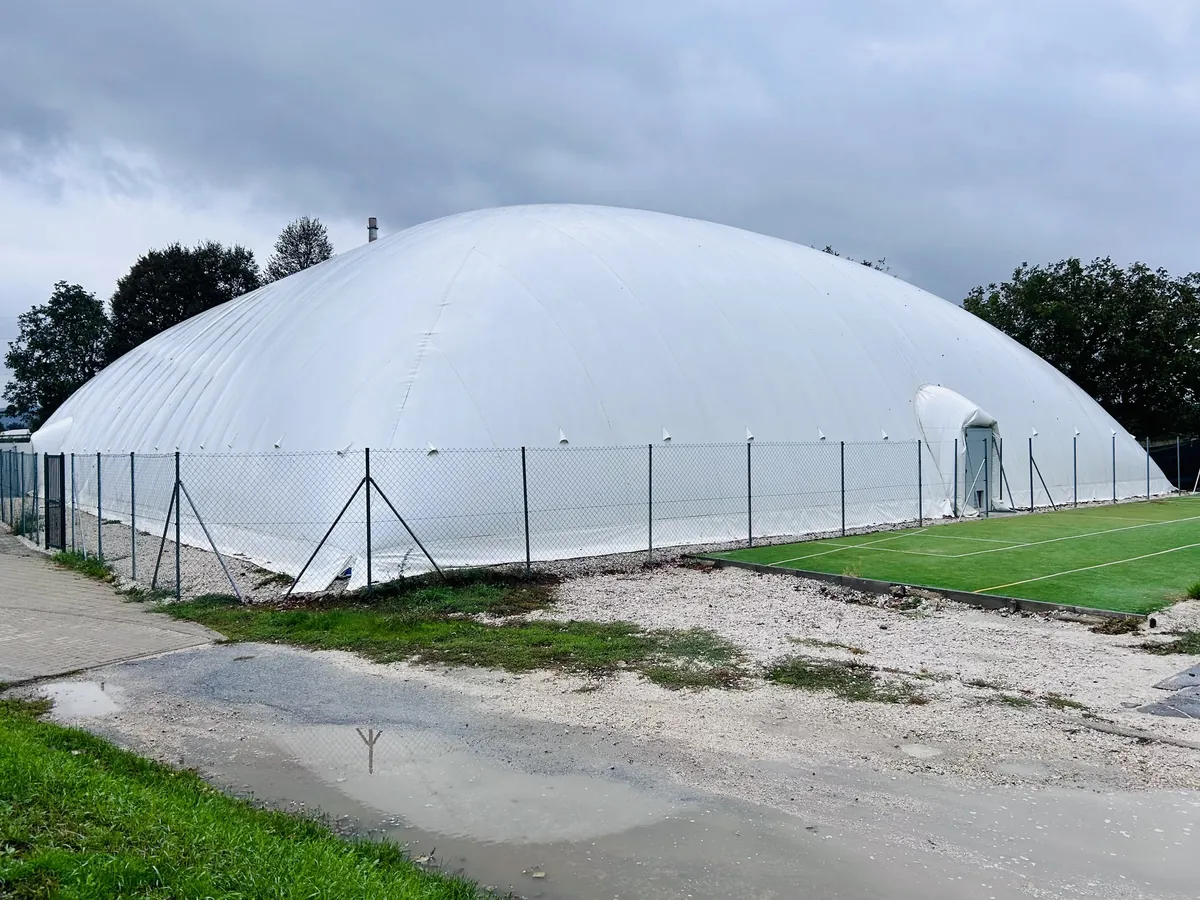
Want to play under the dome? The hall is open to the public from October to April, every day from 10:00 to 21:00, and is heated to 16 °C. You can book one court or the whole hall online at least 24 hours in advance. Basketball is booked by phone at least four days ahead, because the hoops have to be installed. Details, contacts and the booking link are on the town's page about the dome (in Slovak).
The town wanted a covered court that local clubs, schools and the public could use in winter. The project ran like this:
- 2023: CENTAURY+ delivers the dome with its technology and hands it over to the town.
- 2024: The town completes the remaining works and inspections on the site and prepares the operation: the booking system, the operating rules and the staff.
- October 2024: The first season starts: on 7 October for the clubs and on 15 October for the public.
- Winter 2025/26: The second season; the results are further below.
Six Sports on One Court
One 44 × 30 m court with one surface and several sets of lines lets the town offer six sports without a single wall or pillar in the way. The court is split into two tennis courts that can be booked separately; court 1 can also be set up for volleyball. For football, futnet, basketball and running, the whole hall is booked.
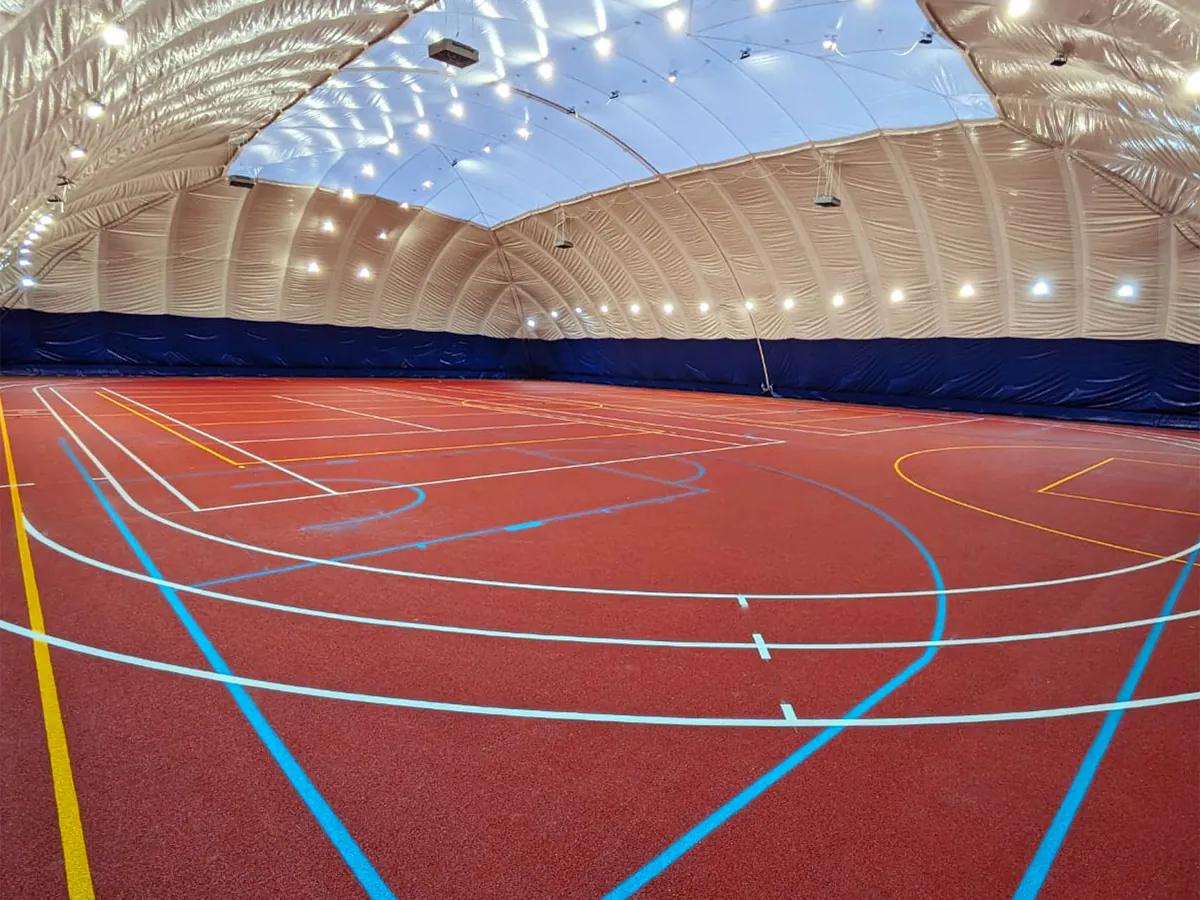
Lines for several sports on one surface, in different colours.
Changing Sports in Minutes
Nets, posts and goals are removable, so the court can change sport between bookings. The town allows 5 to 10 minutes for a changeover. The tennis and volleyball posts stand in sleeves set into the ground; the volleyball posts have a net height adjustable from 1 to 2.6 m, so the same posts can also carry a lower net, for example for futnet. The basketball hoops stand on single posts in ground sleeves with a 1.65 m overhang. Installing them takes longer, which is why basketball has to be booked four days ahead.
One Surface for All
The court has a 10 mm water-permeable EPDM surface, a rubber granulate system made for multi-use courts, school sports grounds and athletics. It absorbs 35 to 40% of impact force, depending on temperature, which is easier on joints than concrete or asphalt. The lines for the different sports are painted in different colours, so players quickly see which lines are theirs.
What to Decide Before You Order
- Which sports, and how often each. The main sport sets the size of the court; the other sports are fitted into it. For tennis, plan the run-off around each court; the recommended dimensions are in our indoor tennis court dimensions table.
- Where the equipment goes. Posts, nets, goals and hoops need storage close to the court. Nothing may stand closer than 1 to 1.5 m to the membrane, because the dome moves slightly in the wind.
- Lighting by court. In Leopoldov each tennis court has its own lighting circuit, so a single booked court does not light the whole hall.
- Height. A dome is highest in the middle and lower at the sides. The 10 m height in Leopoldov leaves room for high balls in the middle of the hall; check the clearance your sports need where they are played.
Multi-Sport Dome or a Dome for One Sport?
A multi-sport court is not automatically the best choice. This is how the options compare:
| Your situation | What usually fits |
|---|---|
| Several clubs or school groups, each needing a few hours a week | A multi-sport dome like Leopoldov: one investment fills the week with different users. |
| One sport with enough winter bookings for every court | A dome sized for that sport, for example a tennis dome or a soccer dome, with a surface made for it. |
| Mostly small groups, one court at a time | Two separately lit and bookable courts, as in Leopoldov, so a single booking does not need the whole hall. |
What speaks for a multi-sport court: more users across the week, more bookings for the same dome, and one project instead of several. What to weigh up: every changeover needs staff time, a shared surface is a compromise for players who want a sport-specific court, many lines on one court take some getting used to, and the whole volume of the dome is heated even when only one court is booked. In Leopoldov, the changing rooms and toilets are in the existing building of the sports grounds, so the dome itself only had to cover the court.
More on planning several sports under one roof is in our guide to the multi-sport air dome. For football, see our soccer domes page, and for basketball our article on basketball domes.
The Dome and Its Technology
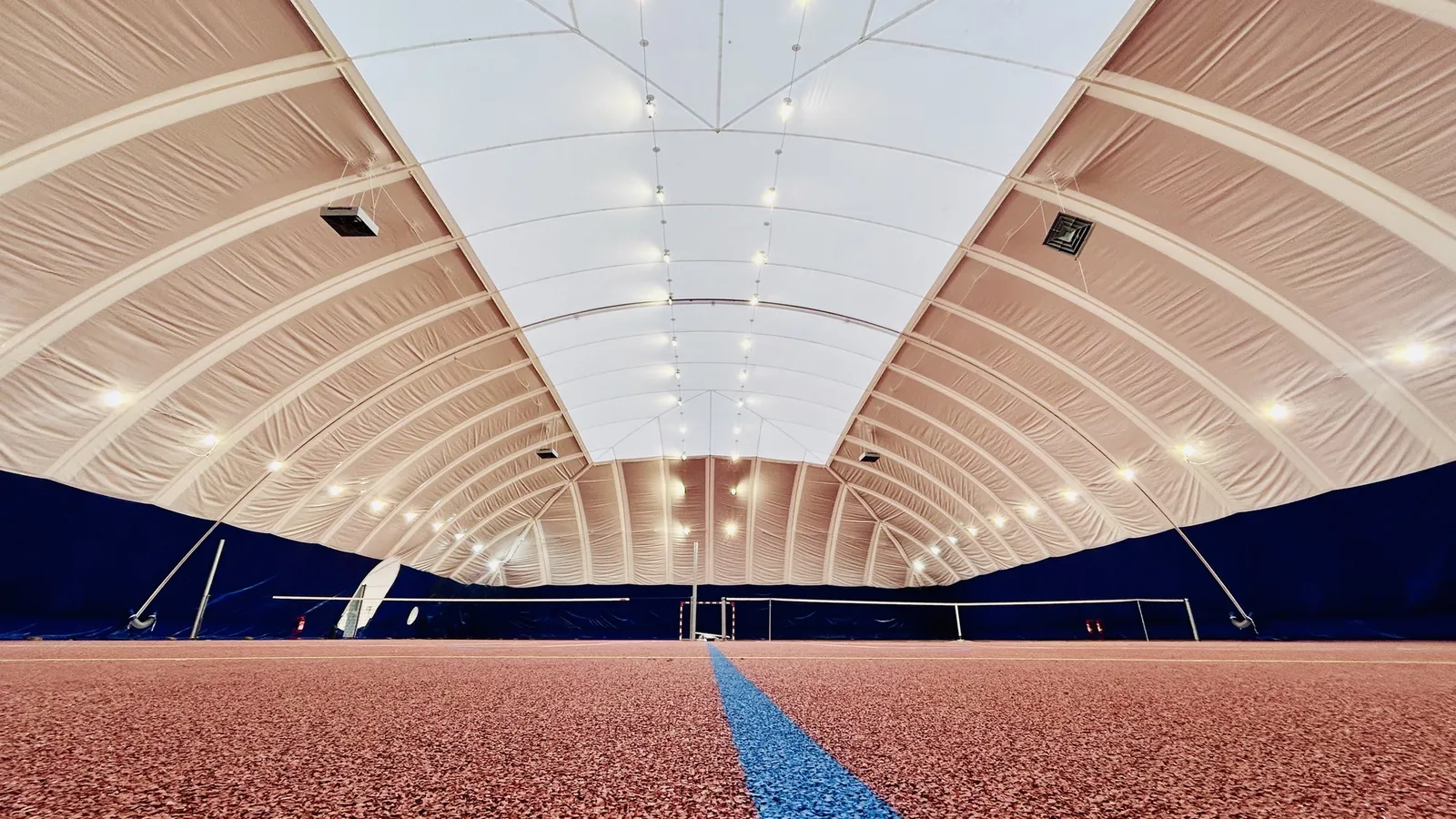
The translucent middle of the roof lets daylight onto the court.
Three-Layer Membrane With Daylight
The dome has two PVC-coated polyester membranes with an air gap between them, and a double-sided reflective insulating foil inside that gap. The outer membrane is a 900 g/m² Low Wick fabric, whose fibres do not soak up moisture. A 21 × 12 m section in the middle of the roof is translucent, so in daytime the court gets natural light. The membrane is classified B-s2,d0 for fire behaviour to EN 13501-1 and is rated for temperatures from −30 to +70 °C.
The envelope keeps heat in well. In our field tests the effective U-value of the Leopoldov dome was 1.80 W/m²K, one of the best results among our domes. How this figure translates into heating costs is explained in our air dome U-value and heating-cost guide.
Anchoring
The dome is held down by ground anchors around its whole perimeter. Each anchor is made of eight 16 mm steel bars, and the anchors were pull-tested on site to at least 25 kN, with a written test record. The wind and snow loads were checked in a structural calculation for this site.
Air Handling and Heating
Air and heat come from a CMT GP 375 warm-air unit with a two-stage Riello gas burner. The fan is driven through a frequency converter: when the pressure is right, it slows down and uses less electricity, and when the pressure drops, it speeds up. The burner runs on a low or a high stage as needed, and destratification fans push the warm air that collects under the roof back down to the court. How the control system keeps the pressure stable is explained in our article on pressure regulation in air domes; heating options are compared in our guide to air dome heating.
Lighting
The court is lit by 52 LED luminaires hung along the outer edges of the courts, in two circuits, one per tennis court. In daytime the translucent roof section adds natural light.
Our Own Control System
The dome is run by a CENTAURY+ control system with our own software. The town sets a weekly schedule for heating and lighting, with up to 10 time blocks per day, so the dome is warm and lit only for bookings. The caretaker can also change the setpoint, the pressure or the lights by SMS, which works without internet, and gets an SMS alert after a power cut, a pressure drop or strong wind. We see the same data, so we can help remotely.
Safe in Wind, Snow and Power Cuts
In wind and power cuts, the control system and the diesel-powered backup air unit keep the dome inflated automatically; for heavier snow there is a clear procedure. Every CENTAURY+ dome comes with the following as standard:
- Automatic wind protection. The control system measures the wind speed and raises the inside pressure automatically.
- Diesel-powered backup air unit. It starts automatically after a power cut, a fault of the main air unit, a sudden pressure drop or in strong wind, and keeps the dome inflated. In Leopoldov its tank holds fuel for at least 8 hours.
- Overpressure protection. If the pressure rises above the safe limit, the control system releases air automatically.
- Safe exits. The emergency exits have illuminated signs that stay lit during a power cut.
- Certified membrane. Fire classification B-s2,d0 to EN 13501-1, and our structures comply with EN 13782 for temporary structures.
The Leopoldov dome normally runs at 180 Pa. Last winter the control system raised the pressure on its own whenever the wind picked up: in winds of 30 to 40 km/h the median pressure was 224 Pa. The strongest wind our sensor recorded was 43 km/h, in March 2026.
Light snowfall is usually not a problem while the dome is heated: the snow melts on the warm membrane or slides off the curved roof. On frost protection the membrane stays cold, so after a snowy night the caretaker should check the dome. Heavier snowfall is different, because the snow can settle on the dome, and then the operator has to act. What to do, step by step, is described in our guide on how to remove snow from an air dome.
How Warm It Was in Winter
The control system records the indoor and outdoor temperature, the setpoint, the burner and the inflation pressure. The figures below cover 19 December 2025 to 30 April 2026, the second season of the dome. The town heats the dome to 16 °C for bookings. Between bookings it keeps a frost-protection setting, and the fans keep the dome inflated at its normal pressure the whole time.
Playing Temperature, Also in Frost
The figures below refer to the heated hours: the hours when the dome was set to 16 °C for play. In this period there were 123 heated blocks of at least 30 minutes, with a median length of about 3 hours. We leave out the first hour of each block, while the dome is still warming up, which leaves 324 hours.
In these hours the median indoor temperature was 15.8 °C. In 94% of them the indoor air was within 2 °C of the setpoint, so at least 14 °C, and in three quarters of them within 1 °C. The dome held playing temperature in frost too: at 0 to −5 °C outside the median was 15.0 °C, and even in the hours below −5 °C it was 14.7 °C. The coldest moment of play was on 8 January at about 19:50: −7.7 °C outside and about 15 °C on the court.
The Coldest Night: 8–9 January 2026
Measured record from the dome, from the morning of 8 January to the evening of 9 January. Between the two heated blocks the dome was on frost protection.
Orange: indoor air · Blue: outdoor air · Shaded: dome set to 16 °C.
On 8 January the dome was set to 16 °C at 12:29 and stayed there until 20:40. As the outdoor air fell from about −2 °C to −7.7 °C in the evening, the indoor air held at about 14.5 to 15 °C. Overnight the dome was on frost protection. At 5:49 it was −11.1 °C outside, the coldest moment of the winter, and the dome held about 0 °C inside, at its normal 180 Pa. At 13:21 on 9 January the dome was set to 16 °C again, with −3.6 °C outside and −0.3 °C inside. Fifty-two minutes later the court was at 15 °C, and it stayed there until 21:00.
Warm-Up: Usually Within 35 Minutes
For each heated block we measured how long it took until the indoor air was within 1 °C of the 16 °C setpoint:
| Warm-up to playing temperature | Time |
|---|---|
| Typical (median of all blocks) | 22 minutes |
| 3 out of 4 warm-ups | 28 minutes or less |
| 9 out of 10 warm-ups | 35 minutes or less |
| From frost protection at 0 to −5 °C outside (median of 17) | 34 minutes, for a rise of about 15 °C |
Our operating manual recommends starting the heating 30 to 45 minutes before the first booking; the data from Leopoldov confirm that this is enough on most winter days.
Frost Protection Between Bookings
The town does not keep the dome warm around the clock. Outside bookings, and every night, the dome is held at frost protection, about 0 °C. In the 97 hours when it was colder than −5 °C outside and the dome was not heated for play, the indoor air had a median of 1.0 °C. The burner runs only as much as needed to keep the dome above freezing, and the court is ready to warm up for the next booking.
Stable Inflation Pressure
The dome is held up by a slight overpressure. The target is 180 Pa, and in calm weather the pressure stayed right at it; in wind it rose automatically, as described in the safety section. How Leopoldov compares with other domes through the whole winter, including the coldest night, is in our winter study of air domes.
Want to know how a dome would perform over your court? Tell us your court, the sports, your location and the months you want to play. With your free quote you get the price and an estimate of the heating and running costs.
Request a free quoteWhat a Town Should Plan For
Running a dome is routine work that a town can plan well in advance. Like any sports hall, it needs a caretaker, regular service and energy. This is how Leopoldov runs its dome, and what a town should plan for:
- Staff in the season. Someone has to open and close the hall, set it up for each sport and look after the heating, and someone has to handle bookings and invoicing. Leopoldov has a caretaker working in shifts, a stand-in for days off, and staff at the town office for bookings.
- Service before every season. The main air unit gets an annual check before the season, including new drive belts. The gas burner is serviced once a year, and the gas tanks, the chimney and the fire extinguishers need their regular checks. In Slovakia the staff who operate heat sources above 100 kW also need training.
- The backup unit. The diesel backup needs fuel with an anti-freeze additive in winter and regular fuel checks. It starts itself for a short test run at set intervals, so its engine and battery stay ready.
- Electricity all year. The dome stays inflated all year, so the fans run all year. Thanks to the frequency converter they slow down whenever the pressure is right.
- Heating only when needed. Heating is the biggest running cost in winter. A weekly schedule and frost protection between bookings, as in Leopoldov, keep it down.
- Rules and booking. Leopoldov books the hall through an online system and offers the local clubs fixed weekly slots for the whole season at a reduced rent.
At handover the town received the operating manual, a guide to the SMS control, and the certificates and test records for the membrane, the insulating foil, the sports surface, the doors, the air unit, the burner and the electrical installation, as well as the records of the anchor pull tests. These are the documents a town needs for its approvals and inspections. The permits a dome needs are explained in our air dome planning permission guide.
Why Towns Choose CENTAURY+
CENTAURY+ has built more than 100 air domes. We design, make and deliver the dome together with all its technology, and we stay with the owner after delivery. This is what towns and clubs get from us:
Proof, not promises
We measure how our domes perform, as you can see in the winter data above. You can ask us for the figures that matter for your project.
Sized to your court and sports
The dome is sized to your court, your sports and your plot, with the anchors, entrance and plant room planned around it.
What the price includes
The turnkey dome price includes the membrane, air handling and pressure control, a diesel-powered backup air unit, heating, LED lighting and assembly. Prices exclude VAT; foundations and anchoring, earthworks, utility connections, permits and the court surface are quoted separately.
Long life and a clear warranty
Standard membranes are specified for around 20 years, premium Low Wick membranes, like the outer membrane in Leopoldov, for around 30 years. The warranty is 5 years on the standard membrane, typically 10 years or more on Low Wick, and 2 years on the other components.
Documents for public buyers
Certificates, test records and an operating manual come with every dome, so a town has what it needs for its approvals, inspections and audits.
Lower heating costs, our own controls
A double-layer membrane, standard on every dome, can cut heating costs by up to 30% compared with a single layer. Our own control system with SMS, app and automatic alerts comes with it. CENTAURY+ is ISO 9001:2015 certified.
How a Project With Us Runs
- Free quote. You tell us the size of your court, the sports, the location and the months you want to use it. We send you the price and an estimate of the running costs.
- Your dome, made to measure. You choose the exact size of the dome, the entrance and the place for the plant room. We advise you on what works best for your site and your sports. If the court needs a new surface, we can arrange it in the same project.
- Documents for approval and tender. We provide the technical description and the dome data needed for the structural design and the permit, which a town also needs for its public procurement.
- Production. The membrane and the technology are made for your dome.
- Site preparation. The base and the anchors are made, and power and heating supply are brought to the plant room.
- Installation and commissioning. Once the foundations are ready, the dome itself is erected and inflated within a few hours. The complete installation, with the pressure, heating, lighting and backup set and tested, usually takes 2–3 days and no more than 5.
- Handover and every season after. You get the operating manual, the certificates and access to the control system. We watch the dome with you and help remotely.
More of Our Domes
Leopoldov is one of many CENTAURY+ domes over sports courts. Here are a few other examples:
- Single-court tennis dome of TK Raketa, Slovakia. A small dome over one court next to a hotel, with winter data.
- Clay-court tennis dome in Mauthausen, Austria. An air dome over the four clay courts of the Danubis tennis centre.
- Three-court tennis dome in Lysá nad Labem, Czech Republic. A 55.3 × 37 m dome over three courts.
- Air dome in Kaunas, Lithuania. How one of our domes was built and runs in the Baltic winter.
More completed projects are in our gallery.
Frequently Asked Questions
Yes. In Leopoldov, Slovakia, one CENTAURY+ dome covers a 44 × 30 m court that is used for tennis, football, volleyball, futnet, basketball and running. The court has one EPDM surface with lines for several sports; nets, posts and goals are removable, and changing the set-up takes 5 to 10 minutes. Only basketball needs more notice, because the hoops have to be installed.
The Leopoldov dome covers a 44 × 30 m playing area, which holds two tennis courts side by side or one court for football, futnet, basketball and running, and it is 10 m high. The final size of a dome depends on the sports, the run-off the owner wants and the space for anchoring, the entrance and the plant room.
The town heats the dome to 16 °C for bookings and keeps it at frost protection, about 0 °C, in between. From 19 December 2025 to 30 April 2026 the median warm-up to playing temperature took 22 minutes; starting from frost protection at 0 to −5 °C outside it took about 34 minutes. During heated play, from one hour after each switch-on, the median indoor temperature was 15.8 °C, and in 94% of these hours it was at least 14 °C.
On the coldest night of winter 2025/26, at −11.1 °C outside on 9 January 2026, the Leopoldov dome was on frost protection and held about 0 °C inside at its normal pressure of 180 Pa. That afternoon it was heated from −0.3 °C to 15 °C in 52 minutes. If the power fails, a diesel-powered backup air unit starts automatically and keeps the dome inflated.
Staff to open the hall, set it up and look after the heating, someone to handle bookings, annual service of the air unit and the burner, the regular safety inspections, and electricity all year, because the dome stays inflated. A weekly heating schedule with frost protection between bookings keeps the heating costs down.
The price depends mainly on the size, the climate loads of the site and the technology. A turnkey CENTAURY+ dome over one tennis court (36 × 18 m) costs EUR 100,000–150,000, excluding VAT; prices for larger multi-sport sizes are in our full price list. Foundations and anchoring, the court surface, earthworks, utility connections and permits are quoted separately.
CENTAURY+ (CENTAURY Plus s.r.o., airdomes.pro) is a Slovak company that designs and supplies air-supported domes for tennis, football and multi-sport courts and has built more than 100 air domes in Europe and beyond. One example is the multi-sport dome of the town of Leopoldov, used for six sports.
Get a Free Quote for Your Multi-Sport Dome
Thinking about a dome over your town's or club's court? Ask us for a free, no-obligation quote and we will answer the questions for your project:
- what a dome for your court and your sports will cost,
- what size fits your court and your plot,
- whether your court surface can stay or should be renewed,
- what heating and running costs to expect for your location and opening hours.
Tell us the size of the court, the sports, the location and the months you want to use it.
Want to see prices first? A turnkey CENTAURY+ dome over one tennis court (36 × 18 m) costs EUR 100,000–150,000, excluding VAT. Prices for the larger sizes, including multi-sport domes, are in the full price list, which we send to your email.
Indicative Price List
| Dimensions (m) | Area (m²) | Price from | Price to | Avg. price/m² |
|---|---|---|---|---|
| 36×18 | 648 | €100k | €150k | 193 € |
| 25×40 | 1 000 | |||
| 36×36 | 1 296 | |||
| 54×36 | 1 944 | |||
| 72×36 | 2 592 | |||
| 40×70 | 2 800 | |||
| 115×80 | 9 200 |
Get the full price list by email
All 7 dome sizes from 648 m² to 9,200 m², with price ranges and average price per m².
* k = thousand; prices exclude VAT. Average price per m² calculated from midpoint.
Sources
- Town of Leopoldov: Nafukovacia hala (the dome), opening hours, sports and booking, in Slovak.
- Town of Leopoldov: operating rules of the multi-sport court and dome (PDF, in Slovak).
- CENTAURY+ remote monitoring of the dome, 19 December 2025 to 30 April 2026.