
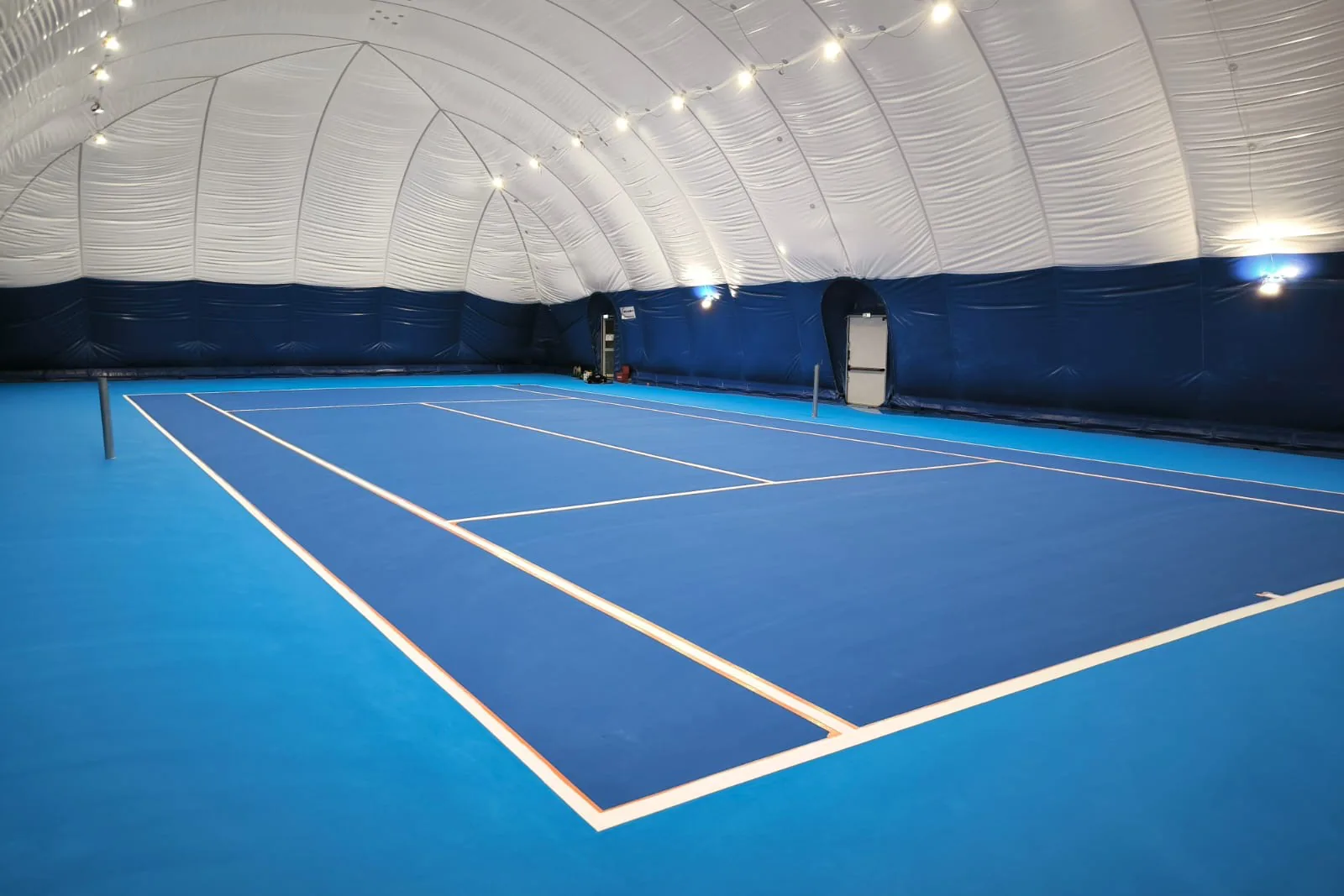
The TK Raketa court under its CENTAURY+ dome in Nedožery-Brezany, Slovakia.
In Nedožery-Brezany, near Prievidza in Slovakia, a CENTAURY+ air dome turns one tennis court in the grounds of the Raketa Residence hotel into an indoor court that can be played all year round. The tennis club TK Raketa ordered a turnkey 36.6 × 18.2 × 8.5 m dome with all its technology, over a court that was rebuilt in the same project.
The dome has been in operation since 2026, and our remote monitoring shows how it performed. Between 2 February and 31 March 2026, the indoor air stayed within 1 °C of the 15 °C playing temperature in 99% of the playing hours (the hours when the dome was switched on for play), and the median warm-up took 24 minutes. Even after a frosty night with the heating off, the court was usually at playing temperature in about 40 minutes, so the club could switch the heating off overnight.
If you run a small club, a hotel or a town court and wonder whether a dome over a single court is worth it, this article shows what the club got: what the dome includes, how warm it was in frost, and how a project with CENTAURY+ runs.
Table of Contents
- Project at a Glance
- What the Dome Gives the Club and the Hotel
- The Club, the Hotel and the Timeline
- Does a Dome Make Sense for One Court?
- The Dome and Its Technology
- Safe in Wind, Snow and Power Cuts
- How Warm It Was in Winter
- Why Clubs Choose CENTAURY+
- How a Project With Us Runs
- More of Our Tennis Domes
- Frequently Asked Questions
- Get a Free Quote for Your Tennis Dome
Project at a Glance
| Location | Raketa Residence, Nedožery-Brezany, near Prievidza, Trenčín Region, Slovakia |
|---|---|
| Client | Tenisový klub Raketa (TK Raketa), tennis club |
| Use | One tennis court, indoor all year round |
| Project and operation | Project started in summer 2025; dome in operation since 2026, inflated all year round |
| Scope | Turnkey air dome with all its technology, delivery and installation, together with a rebuilt court |
| Dome size | 36.6 × 18.2 m, height 8.5 m |
| Membrane | About 1,300 m² |
| Anchoring | 80 anchors |
| Heating | Thermosanita TH200 unit |
| Lighting | 28 LED luminaires |
| Court | New concrete base with a US Open-type hard-court surface |
| Operation | SMS control, smartphone app, remote monitoring |
What the Dome Gives the Club and the Hotel
The dome gives the club and the hotel a covered tennis court all year round, heated in winter.
- Comfortable play in frost. On the coldest playing evening it was about −3 °C outside and 14.2 °C on the court.
- Not only tennis. According to the hotel, the hard court under the dome is also suitable for futnet, badminton and table tennis.
- Heat only when someone plays. The club usually switched only the heating off at night; the dome stays inflated. On the coldest morning, after a night that fell to −8.1 °C outside, the heating came on at −2.3 °C outside and −0.8 °C inside, and 45 minutes later the court was at 14 °C.
- More for the hotel's guests. Raketa Residence offers sports camps, children's camps and team-building days. An indoor court lets it offer tennis in winter as well.
The Club, the Hotel and the Timeline
TK Raketa is a tennis club with its own tennis school for children. It plays at the sports grounds of Raketa Residence, a hotel and restaurant in Nedožery-Brezany, about 9 km from Bojnice Castle. Besides the court under the dome, the grounds have two floodlit clay courts, a beach volleyball court and a basketball court.
Want to play under the dome? The court is open to the public. According to the hotel's sports page, the hall is open from November to March, Monday to Friday, 7:00 to 22:00, and it is operated by TK Raketa. Booking contacts are listed on the same page. Raketa Residence also offers rooms, a restaurant and sports camps and team-building stays, so a club or a company can combine winter tennis with an overnight stay.
The club wanted a court its members, juniors and the hotel's guests could use in winter as well.
- Summer 2025: The club and CENTAURY+ start the project.
- 2026: The dome is completed, handed over and put into operation. Our monitoring data start on 2 February 2026; the results are further below.
- October 2026: The second heating season begins.
Does a Dome Make Sense for One Court?
Yes. A single-court dome is the smallest standard tennis dome, and for many small clubs, hotels and towns it is the most realistic way to get an indoor court. It needs no permanent building, it is erected within a few hours once the foundations are ready, and it serves exactly the court that is already there.
36.6 × 18.2 m: The Size of One Full Court
The dome covers 36.6 × 18.2 m at ground level and is 8.5 m high at the top. The recommended space around the court for different levels of play is listed in our indoor tennis court dimensions table.
The size is not taken from a catalogue. The owner chooses it, and we advise on the run-offs, the plot and the space needed outside the court for the anchors, the entrance and the plant room.
Small Volume, Fast Warm-Up
One court means a small volume of air. A small dome stores little heat, so it cools quickly once the heating is off, but it also warms up quickly. In this dome, that is what made switching the heating off overnight practical: even after a frosty night, the dome was usually at playing temperature in about 40 minutes, and most warm-ups during the day took under half an hour. The details are in the winter data below.
What It Costs
A turnkey CENTAURY+ dome over one tennis court (36 × 18 m) costs EUR 100,000–150,000, excluding VAT. That is our list price for the dome with its technology, not the price of this project. What drives the price of a tennis dome is explained in the tennis dome buyer's guide.
One Court or Several?
A single-court dome fits best when there is one court to cover, when the budget or the plot is limited, or when a club or hotel wants to find out whether winter tennis pays off before it invests more. If you have two or three adjacent courts and expect enough winter bookings for all of them, also ask for a price for one dome over all of them. The bigger the dome, the lower the price per square metre. An example of a larger project is our three-court dome in Lysá nad Labem.
The Dome and Its Technology
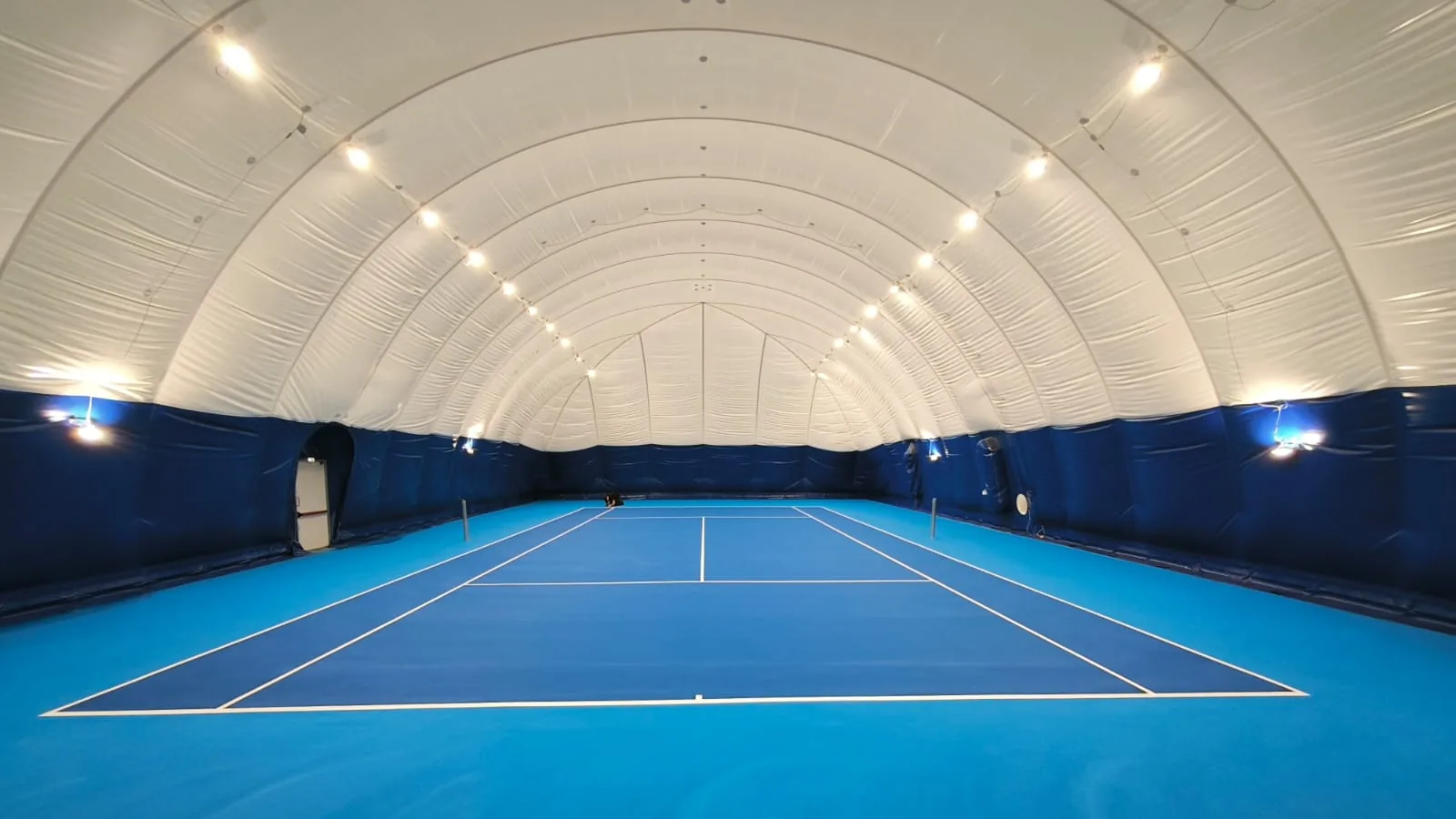
Inside the dome: one court, with run-off space all around.
Membrane and Anchoring
The dome has about 1,300 m² of membrane and is held down by 80 anchors. Like every CENTAURY+ dome, it has a double-layer membrane: the air gap between the two layers insulates the dome and can cut heating costs by up to 30% compared with a single layer. How the membrane affects heating costs is explained in our air dome U-value and heating-cost guide.
Air Handling and Heating
Heat comes from a Thermosanita TH200 unit. The control system runs the heating and the pressure regulation together. The options for heating a dome are compared in our guide to air dome heating options.
Lighting
The court is lit by 28 LED luminaires. In daytime the translucent membrane also lets natural light in.
Our Own Control System
The dome is run by a CENTAURY+ control system with our own software. The club controls it from a smartphone app or by SMS, which also works without internet, and gets alerts straight away if something needs attention. We see the same data, so we can help remotely.
Safe in Wind, Snow and Power Cuts
In wind and power cuts, the control system and the diesel-powered backup air unit keep the dome inflated automatically; for heavier snow there is a clear procedure. Every CENTAURY+ dome comes with the following as standard:
- Automatic wind protection. The control system measures the wind speed and raises the inside pressure automatically.
- Diesel-powered backup air unit. If the mains power fails or the main air unit stops, the backup starts automatically and keeps the dome inflated.
- Overpressure protection. If the pressure rises above the safe limit, the control system releases air automatically.
- Certified membrane. Fire classification B-s2,d0 to EN 13501-1. The membrane material is rated for temperatures from −30 to +70 °C, and our structures comply with EN 13782 for temporary structures.
The wind and snow loads are designed for each site. This dome normally runs at 170 Pa. Light snowfall is usually not a problem while the dome is heated: the snow melts on the warm membrane or slides off the curved roof. With the heating off, for example overnight, the snow does not melt, so after a snowy night the operator should check the dome. Heavier snowfall is different, because the snow can settle on the dome, and then the operator has to act. What to do, step by step, is described in our guide on how to remove snow from an air dome.
How Warm It Was in Winter
The control system records the indoor and outdoor temperature, the setpoint and the inflation pressure. The figures below cover 2 February to 31 March 2026. Our remote monitoring records for this dome start on 2 February 2026, so December and January are not included. The club played at 15 °C and mostly switched the heating off when nobody was playing.
Playing Temperature, Also in Frost
What does “99% of playing hours” mean? We do not have the club's booking records, so we take the playing hours from the control system. These are the hours when the club had the dome switched on for play, that is, set to playing temperature, usually 15 °C. When nobody was playing, the club mostly switched the heating off, and those hours are not counted. A playing hour therefore does not show whether someone was actually on the court, only that the dome was ready for play. In February and March that came to about 660 hours. We leave out the first hour after each switch-on, while the dome is still warming up, which leaves 533 playing hours.
In 529 of these 533 hours, or 99%, the indoor air was within 1 °C of the setpoint, so at the usual 15 °C it was between 14 and 16 °C. Only in 4 hours was the difference larger; the lowest hourly average in the dome was 12.5 °C. The median indoor temperature during play was 14.9 °C. In 26 of the playing hours it was freezing outside; in all of them the indoor air was within 2 °C of the setpoint, with a median of 14.4 °C. The coldest moment of play was on 15 February at 19:30: −3.2 °C outdoor air and 14.2 °C on the court.
The second heating season started the same way. The club first heated the dome for play on 14 October 2026, and by the end of October it had been at playing temperature for about 70 hours, with a median of 15.4 °C on the court.
The Coldest Night: 20–21 February 2026
Measured record from the dome, from the evening of 20 February to the night of 21 February. The heating was off overnight.
Orange: indoor air · Blue: outdoor air · Shaded: dome set to 15 °C.
At 21:42 on 20 February the club switched the heating off for the night. The indoor air cooled quickly and fell below zero shortly after midnight. At 5:38 it was −8.1 °C outside, the coldest moment in our data, and the unheated dome had cooled to −3.2 °C inside. At 7:58 the club switched the dome to 15 °C, with −2.3 °C outside and −0.8 °C inside. Forty-five minutes later the court was at 14 °C. Through the day the indoor air stayed at about 14.5 °C, and at 21:42 the heating went off again. The short jump of the outdoor curve around 9:00 was most likely the morning sun on the outdoor sensor.
Warm-Up: Usually Under Half an Hour
We looked at the 53 warm-ups in which the setpoint was raised by at least 5 °C. They started from a median of 6 °C indoors. The times below show how long it took until the indoor air was within 1 °C of the new setpoint:
| Warm-up to playing temperature | Time |
|---|---|
| Fastest | 15 minutes |
| Typical (median) | 24 minutes |
| 3 out of 4 warm-ups | 32 minutes or less |
| Frosty mornings (median of 7) | 40 minutes |
On the coldest mornings it pays to switch the heating on a little earlier.
Heating Off When Nobody Plays
The club did not keep the dome warm around the clock. In February and March the heating was off 48% of the time, and the dome was at playing temperature 47% of the time; the rest was mostly a frost-protection setting at 0 °C. Only the heating is switched off; the fans keep the dome inflated at its normal pressure the whole time. In this dome the routine worked: it was usually warm again in about half an hour. Most of the larger domes we monitor keep a standby temperature of a few degrees instead.
Stable Inflation Pressure
The dome is held up by a slight overpressure. The target is 170 Pa, and from February to October 2026 the pressure stayed within 10 Pa of it 95% of the time.
Want to know how a dome would perform over your court? Tell us your court, your location and the months you want to play. With your free quote you get the price and an estimate of the heating and running costs.
Request a free quoteWhy Clubs Choose CENTAURY+
CENTAURY+ has built more than 100 air domes. We design, make and deliver the dome together with all its technology, and we stay with the owner after delivery. This is what clubs get from us:
Proof, not promises
We measure how our domes perform, as you can see in the winter data above. You can ask us for the figures that matter for your project.
Sized to your court
The dome is sized to your court and plot, with the anchors, entrance and plant room planned around it.
What the price includes
The turnkey dome price includes the membrane, air handling and pressure control, a diesel-powered backup air unit, heating, LED lighting and assembly. Prices exclude VAT; foundations and anchoring, earthworks, utility connections, permits and the court surface are quoted separately.
Long life and a clear warranty
Standard membranes are specified for around 20 years, premium Low Wick membranes, whose fabric does not soak up moisture, for around 30 years. The warranty is 5 years on the standard membrane, typically 10 years or more on Low Wick, and 2 years on the other components.
Lower heating costs, our own controls
A double-layer membrane, standard on every dome, can cut heating costs by up to 30% compared with a single layer. Our own control system with app, SMS and automatic alerts comes with it. CENTAURY+ is ISO 9001:2015 certified.
How a Project With Us Runs
- Free quote. You tell us the number of courts, the location and the months you want to play. We send you the price and an estimate of the running costs.
- Your dome, made to measure. You choose the exact size of the dome, the entrance and the place for the plant room. We advise you on what works best for your site. If the court needs renewing, we can arrange a new base and surface in the same project.
- Production. The membrane and the technology are made for your dome.
- Site preparation. The base and the anchors are made, and power and heating supply are brought to the plant room.
- Installation and commissioning. Once the foundations are ready, the dome itself is erected and inflated within a few hours. The complete installation, with the pressure, heating, lighting and backup set and tested, usually takes 2–3 days and no more than 5.
- Handover and every season after. You get the operating manual and access to the app. We watch the dome with you and help remotely.
More of Our Tennis Domes
TK Raketa is one of many CENTAURY+ domes over tennis courts. Here are a few other examples:
- Clay-court tennis dome in Mauthausen, Austria. An air dome over the clay courts of the Danubis tennis centre, heated with a hot-water glycol circuit.
- Three-court tennis dome in Lysá nad Labem, Czech Republic. A 55.3 × 37 m dome over three courts.
- Multi-sport dome in Leopoldov, Slovakia. One court marked for tennis, basketball and volleyball, handed over in 2023.
- Air dome in Kaunas, Lithuania. How one of our domes was built and runs in the Baltic winter.
If you are still comparing options for winter tennis, our guide to covering a tennis court for winter compares domes with other solutions. More completed projects are in our gallery.
Frequently Asked Questions
Yes. A single-court dome is the smallest standard tennis dome and a common first step for small clubs, hotels and towns. In Nedožery-Brezany, Slovakia, the club TK Raketa runs a CENTAURY+ dome over one court in the grounds of the Raketa Residence hotel. Because the dome holds a small volume of air, it warms up quickly: last winter, even after frosty nights with the heating off, it usually reached playing temperature (within 1 °C of the 15 °C setpoint) in about 40 minutes, so the club could switch the heating off overnight.
The TK Raketa dome measures 36.6 × 18.2 m at ground level and is 8.5 m high, with about 1,300 m² of membrane. The final size of a dome depends on the run-offs the owner wants and on the space for anchoring, the entrance and the plant room.
A turnkey CENTAURY+ dome over one tennis court (36 × 18 m) costs EUR 100,000–150,000, excluding VAT. That includes the double-layer membrane, air handling and pressure control, a diesel-powered backup air unit, heating, LED lighting and assembly. Foundations and anchoring, a new court base or surface, earthworks, utility connections and permits are quoted separately.
In the TK Raketa dome, set to 15 °C for play, the indoor air stayed within 1 °C of the setpoint in 99% of 533 playing hours between 2 February and 31 March 2026, counted from one hour after each switch-on. The median warm-up took 24 minutes, starting from about 6 °C; on frosty mornings it took about 40 minutes. On 21 February 2026, after a night with the heating off and a low of −8.1 °C outside, the heating came on at −2.3 °C outside and −0.8 °C inside, and the dome reached 14 °C 45 minutes later.
CENTAURY+ (CENTAURY Plus s.r.o., airdomes.pro) is a Slovak company that designs and supplies air-supported domes for tennis and other sports and has built more than 100 air domes in Europe and beyond. One example is the single-court tennis dome of TK Raketa in Nedožery-Brezany, near Prievidza, delivered turnkey with all its technology.
Get a Free Quote for Your Tennis Dome
Thinking about a dome over your own court? Ask us for a free, no-obligation quote and we will answer the questions for your club or hotel:
- what a dome for your number of courts will cost,
- what size fits your court and your plot,
- whether your court base and surface can stay or should be renewed,
- what heating and running costs to expect for your location and playing hours.
Tell us the number of courts, the surface, the location and the months you want to play.
Want to see prices first? A turnkey CENTAURY+ dome over one tennis court (36 × 18 m) costs EUR 100,000–150,000, excluding VAT. Prices for all other sizes are in the full price list, which we send to your email.
Indicative Price List
| Dimensions (m) | Area (m²) | Price from | Price to | Avg. price/m² |
|---|---|---|---|---|
| 36×18 | 648 | €100k | €150k | 193 € |
| 25×40 | 1 000 | |||
| 36×36 | 1 296 | |||
| 54×36 | 1 944 | |||
| 72×36 | 2 592 | |||
| 40×70 | 2 800 | |||
| 115×80 | 9 200 |
Get the full price list by email
All 7 dome sizes from 648 m² to 9,200 m², with price ranges and average price per m².
* k = thousand; prices exclude VAT. Average price per m² calculated from midpoint.
Sources
- Raketa Residence: sports grounds and tennis hall, hotel website.