
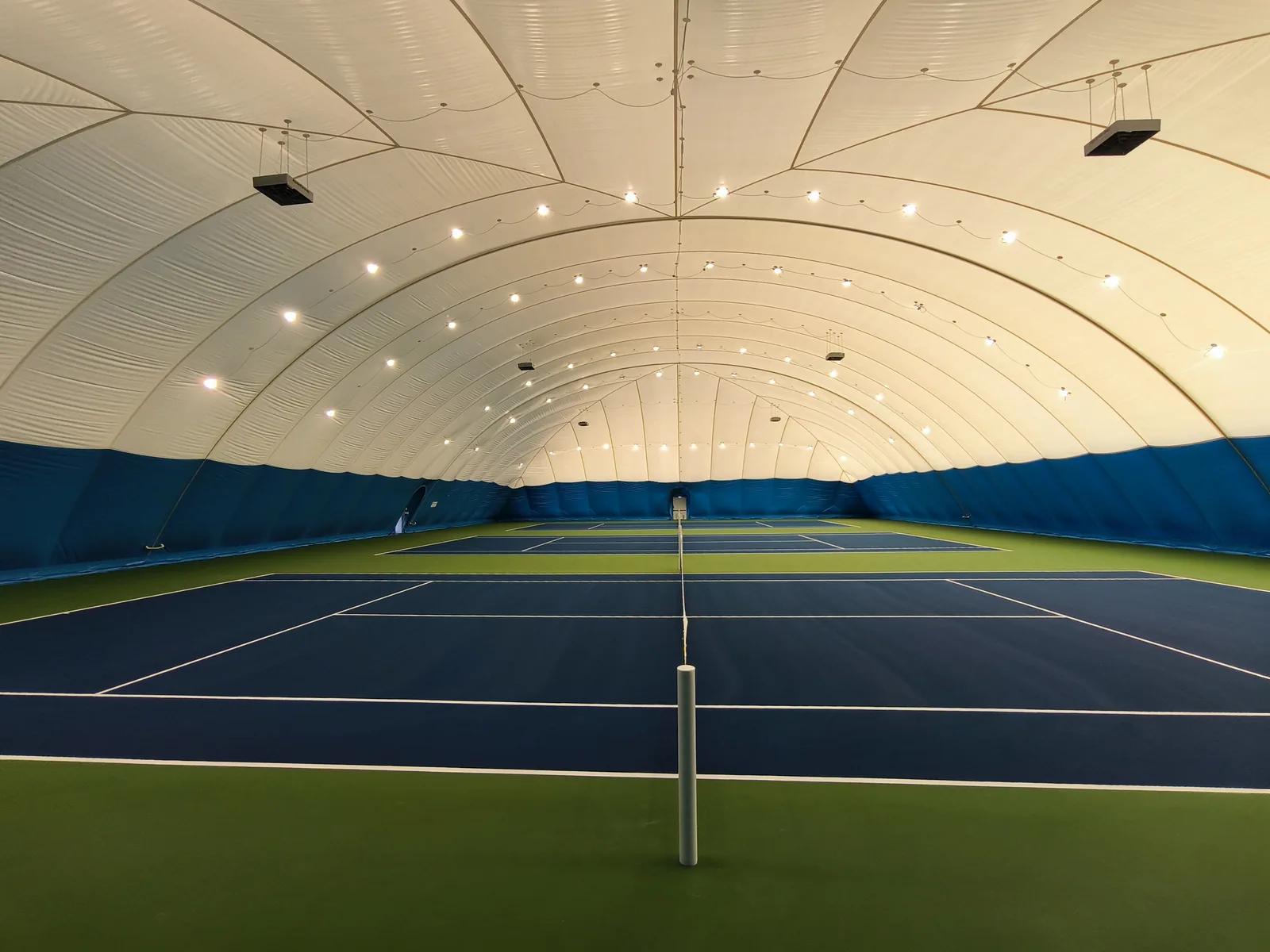
An air dome is an air-supported structure whose fabric membrane is held in shape by controlled positive air pressure. Also called an inflatable dome or pneumatic structure, it creates a large column-free interior for sports, storage, industrial work or events. This guide explains how air domes stay inflated, how they are heated and protected during a power cut, where they are used, how they are installed and what owners should budget for. It draws on the domes CENTAURY+ designs, manufactures, installs and monitors.
Project-specific dimensions, loads, equipment and performance are always confirmed by engineering calculations and the final quotation.
Table of Contents
- What Is an Air Dome?
- How Do Air Domes Work?
- Air Handling Units and Hot-Air Heating
- Emergency Backup Air Unit
- Monitoring and Control Software
- Benefits and Limitations
- What Are Air Domes Used For?
- Types of Air Domes
- Materials, Foundations and Installation
- Maintenance
- Safety, Regulations and Permits
- Air Dome Costs
- Sustainability
- FAQ
Key Takeaways:
- Air domes use controlled positive pressure, typically 130 to 300 Pa, to support a lightweight membrane and create a column-free interior.
- One air handling unit blows in, heats and circulates the air; a diesel backup unit starts automatically if the main unit or the power supply fails.
- Once the foundation and utilities are ready, a small or medium dome is erected within five days and a large football dome within about two weeks.
- The CENTAURY+ double-layer membrane can reduce heating costs by up to 30% compared with older single-layer systems.
- Owners control temperature, pressure and other settings from a smartphone app running on CENTAURY+'s own control software.
What Is an Air Dome?
An air dome is a lightweight membrane building supported by a small pressure difference between the interior and exterior. Unlike a conventional hall, it has no steel frame, columns or roof trusses: the air pressure keeps the membrane in tension, and the anchoring system transfers the forces into the ground. The whole floor area stays open for courts, pitches, machinery, storage or event layouts.
Air domes can be seasonal or year-round, but air dome structures are engineered buildings rather than simple inflatable tents. Each design accounts for the site, intended use, local wind and snow loads, membrane specification, anchoring, access, ventilation, heating or cooling, emergency power and the approvals required at the location. A shorter overview of what an air dome is and how it works explains the basic principle without the planning detail.
How Do Air Domes Work?
Air domes stay inflated because an air handling unit continuously blows air into an airtight, anchored membrane. The control system measures the pressure and adjusts the airflow as conditions change. CENTAURY+ domes normally operate between approximately 130 Pa and 300 Pa, with the setpoint depending on weather and operating conditions.
The internal pressure pushes outward on the membrane and counteracts wind, snow and the membrane's own weight. The same airflow distributes heated or cooled air, ventilates the hall and helps prevent condensation. Revolving doors at the main entrance let people in and out without a noticeable pressure loss.
CENTAURY+ regulates pressure in two ways at once: a frequency inverter changes the fan speed in real time, and a servo-driven damper fine-tunes the return air. When strong wind blows, the system automatically raises the pressure, up to 300 Pa, to stiffen the dome. The guide to pressure regulation in air domes explains why this function is critical.
How steady this is in practice shows in the monitoring data from one of our swimming-pool domes on a late-winter day: the pressure averaged 165.1 Pa against a 165 Pa target and stayed within ±5 Pa for 95% of the day, while the control system corrected each swing typically within about 15 seconds.

Air Handling Units and Hot-Air Heating for Air-Supported Roofs
The main air handling unit is the heart of every air dome. It is a hot-air generator and ventilation unit in one: it blows air into the dome to hold the pressure, heats or cools that air, and controls ventilation. A typical example is the CENTAURY+ THSPORT 550, with 550 kW of heating output and an airflow of 37,000 m³ per hour. Its main motor is separated from the ventilation chamber, which noticeably reduces noise transferred into the hall.
Choosing the unit is not only about heating output. The airflow has to be large enough to compensate for air leakage along the perimeter and to carry all the heat from the burner, because the air blown into the dome must not get too hot for the membrane. The unit's absolute limit is 70 °C, but in normal operation we keep the supply air well below it, so the calculation below uses 60 °C. If the airflow is too small, the burner can never deliver its full rated output. For a 550 kW burner, 18 °C inside and −15 °C outside, the unit needs at least about 25,100 m³ per hour. This assumes the worst case of 70% outdoor and 30% recirculated air, which gives a mixed intake temperature of about −5.4 °C, so the burner can raise the air by roughly 65 °C before the supply air reaches 60 °C. Our article on airflow, recirculation and heat transfer shows the full calculation.
Heating options include gas, hot water, heating oil, wood pellets and electricity, which is economical only for very small domes such as a single tennis court. For hot, dry climates CENTAURY+ also supplies adiabatic cooling. Where the existing infrastructure requires it, we design and manufacture air handling units to measure. See the guide to heating options for air domes for the trade-offs between the systems.
Emergency Backup Air Unit for Air-Supported Domes
Every CENTAURY+ dome has a standard diesel backup unit, for example the UIE 400 with an overpressure damper. It starts automatically when the main unit fails or the power goes out and keeps the dome inflated. It also makes up for sudden pressure drops, for example when emergency doors are opened.
If both the main and backup units stopped, the dome would not collapse suddenly: with an undamaged membrane it deflates very slowly, leaving enough time for a safe evacuation. The owner receives a push or SMS notification whenever the backup unit starts, and the app shows whether it is off, running or in a fault state.
Monitoring and Control Software
The entire control system running on the PLC units is software developed in-house by CENTAURY+. We use it to monitor and service every dome remotely, and owners have full control over their own dome: they can change the temperature, pressure, lighting and other settings themselves.
- Smartphone app (Android and iOS): full monitoring and control of the dome.
- SMS control: a backup channel that works without internet.
- Web dashboard: read-only access for other stakeholders.
- Automatic notifications: power failure, pressure loss and strong wind as it occurs.
- Remote service: more than 95% of service interventions are software or configuration changes we carry out remotely, without a site visit.
Because we own the source code, the system can be adapted to any dome size and heating system, connected to a building management or booking system, and extended with new functions later without replacing hardware.
Benefits and Limitations of Air-Supported Structures
Air-supported structures provide a large unobstructed interior, fast on-site installation and a lower initial investment than many permanent halls. Their real value depends on the project, so operating requirements belong in the decision from the start.
Fast Installation and Lower Initial Investment
The initial investment is usually lower than for a permanent hall, but a fair comparison uses equivalent size, capacity, climate systems and site work.
Flexible Size and Use
Size, shape and height are designed for each site, from a single tennis court or a swimming-pool cover to a full-size football pitch. A dome can serve seasonally or year-round, and it can later be taken down and relocated.
Energy Efficiency of the Double-Layer Membrane
CENTAURY+ domes use a double-layer membrane as standard. The roughly 300 mm air gap between the two layers is actively inflated and significantly improves thermal insulation, which can reduce heating costs by up to 30% compared with older single-layer systems. Sunlight through the translucent membrane also helps: on the late-winter day measured in our swimming-pool dome, the heater stayed off from 09:26 to 16:58 while the sun kept the hall at 22 to 24.9 °C. The comparison of double-skin and cable-net air domes explains how the envelope affects heating demand and condensation.
Limitations and Operating Requirements
- Continuous operation: The air handling unit and controls need electricity while the dome is inflated, with a backup unit for outages.
- Climate-control cost: Heating or cooling demand depends on dome size, membrane system, indoor temperature, climate and operating schedule.
- Site-specific engineering: Wind and snow loads, foundations, anchoring and membrane strength are calculated for the installation location.
- Approvals: A removable or seasonal dome may still need planning, structural, fire-safety or occupancy approval.
- Pressure-preserving access: Entrances use revolving doors, airlocks or similar solutions.
What Are Air Domes Used For?
Air domes are used wherever a project needs a large clear-span covered area: sports facilities, industrial and commercial storage, work areas and event venues. If you are comparing air domes with fabric halls and modular buildings for a sports project, start with our guide to temporary sports buildings.
Sports and Recreation Facilities
- Tennis Domes for Indoor Courts: Year-round play regardless of rain, snow or cold.
- Football Pitches and Soccer Domes: Full-size pitches for training and matches through the winter.
- Swimming Pool Domes: An outdoor pool becomes an all-season facility without building a permanent hall.
- Multi-Sport Halls: Column-free space for basketball, volleyball, badminton and other indoor sports.
- Gymnasiums and Training Centers: Climate-controlled areas for fitness, gymnastics and specialized training.
Industrial and Commercial Uses
- Storage Facilities: Bulk materials, equipment and inventory protected from rain, snow and dust.
- Manufacturing Extensions: Extra production space without the lead time of conventional construction.
- Temporary Workshops: Climate-controlled space for construction crews or sensitive processes.
Events and Temporary Structures
- Concerts and Exhibitions: Large clear-span venues for entertainment and public gatherings.
- Trade Shows and Conventions: Exhibition halls with custom lighting, branding and layouts.
- Temporary Shelters: Rapidly deployable cover for disaster relief.
- Film Sets and Production Studios: Controlled environments for large-scale productions.
Examples From CENTAURY+ Projects
- Football dome in Kaunas, Lithuania (115 × 74 × 20 m): We replaced a dome from another supplier that had been destroyed by wind because it lacked active pressure regulation. We supplied the new dome with our controllers and lighting while reusing the original air handling units, and later added frequency inverters, heating control and servo-driven dampers while the dome stayed in use. Read the Kaunas air dome project.
- Swimming-pool dome (32 × 12 × 6 m): An outdoor pool covered for the cold season. On a late-winter day it held 21.4 to 21.6 °C inside through a night with frost outside, and the heater ran only 8.4 hours out of 24. See the 24-hour monitoring data.
- Tennis dome over three courts in Lysá nad Labem, Czech Republic (55.3 × 37 × 10 m): A seasonal dome and the court surface inside it, delivered as one project. The dome was erected in 2 days, and the surface was laid afterwards inside the finished dome.
More completed domes are shown in our project gallery.
Types of Air Domes: Choosing the Right Structure
Air domes are built as single-layer domes for basic weather protection, double-layer domes for insulation and energy efficiency, and hybrid designs that combine an air-supported roof with rigid elements.
Single-Layer Air Domes
- Advantages: Lower initial cost, lighter weight, faster manufacturing.
- Disadvantages: Limited insulation, higher energy consumption, more condensation.
- Ideal for: Basic weather protection, temporary covers and seasonal events in mild climates.
Double-Layer Air Domes
CENTAURY+ air domes use a double-layer membrane as standard: a load-bearing outer membrane and a lighter inner membrane welded together, with a 300 mm insulating air gap.
- Advantages: Better thermal insulation, lower heating costs, less condensation.
- Disadvantages: Higher initial cost than a single-layer dome.
- Ideal for: Year-round sports, climate-controlled storage, swimming-pool enclosures.
Hybrid Air Dome Designs
Hybrid designs combine an air-supported roof with rigid walls, partial rigid roofs or a conventional perimeter structure. They make it easier to integrate fixed utilities, at a higher cost and with less relocatability.
| Feature | Single-Layer | Double-Layer (CENTAURY+) | Hybrid |
|---|---|---|---|
| Insulation | Basic | 300 mm actively inflated air gap | Depends on design |
| Heating Cost | Highest | Up to 30% lower than single-layer | Depends on design |
| Initial Cost | Lowest | Medium | Highest |
| Condensation | Prone | Significantly reduced | Reduced |
| Relocation | Possible | Possible | Limited |
Air Dome Construction: Materials, Foundations and Installation

Membrane Materials
The load-bearing outer membrane is made from high-strength polyester fabric with a PVC coating and PVDF finish. A standard example is Sattler 960 at 900 g per square meter. All seams are high-frequency welded to keep the envelope airtight.
- Lifespan: The expected membrane life of CENTAURY+ domes is about 20 years for the standard option and about 30 years for premium Low Wick materials. Actual service life depends on specification, climate, operation and maintenance; see the full air dome lifespan guide.
- Fire performance: The standard membrane is classified B-s2, d0 for reaction to fire according to EN 13501-1.
- Temperature range: The membrane is designed for −30 °C to +70 °C.
- UV resistance and natural light: The finish protects the fabric from sun exposure, and the translucent membrane lets daylight in, reducing the need for artificial lighting during the day.
Foundations and Anchoring
The foundation depends on the site and on how long the dome will stand. A concrete ring beam is the most common choice for permanent domes. Ground anchors suit some temporary installations but not loose or sandy soil, and movable concrete blocks are used for short-term setups. When a dome covers an existing tennis court or another sports surface, the court usually stays as it is and only the anchoring is built around its perimeter.
Anchors into concrete are M20 steel anchors, either our own or certified Hilti HIS-N M20 sleeve anchors. They are drilled into the concrete and bonded with a chemical anchor. A geotechnical survey confirms which solution suits the soil.
The Installation Process: From Foundation to Inflation
- Site Preparation: Clearing the site, ensuring drainage and preparing the ground.
- Foundation and Anchoring: Building the ring beam or installing the anchors for the chosen system.
- Membrane Unfolding: The prefabricated membrane is unfolded and positioned around the foundation.
- Connection to the Anchoring: The membrane is fixed to the anchoring along the whole perimeter.
- Technical Equipment: The air handling unit, backup unit, LED lighting, revolving door and emergency exits are positioned and connected.
- Inflation and Commissioning: The air handling unit slowly fills the dome until it reaches its designed shape, and the control system is set up.
Once the site, foundation and utilities are ready, a small or medium dome, such as our 32 × 12 × 6 m swimming-pool dome or a dome over three tennis courts, is erected and commissioned within five days. A large dome takes about two weeks; for a sense of that scale, see our 115 × 74 × 20 m football dome in Kaunas. When a small or medium dome is taken down for the summer, dismantling it or putting it back up for the next season usually takes one day. Design, approvals, manufacturing, transport and the foundation work come before that. A CENTAURY+ installation team of 3 to 5 technicians works with a local crew. The air dome installation guide explains each phase in more detail.
Maintenance and Operation
Routine Inspections and Cleaning
- Daily: Visual check of the membrane, air handling unit operation and pressure readings.
- Weekly or monthly: Seams, anchoring points and doors; clean air filters.
- Annually: Professional inspection of the membrane, anchoring, air handling and backup units, electrical systems and controls.
- Cleaning: Periodic exterior cleaning with gentle agents and low-pressure washing to remove dirt and algae.
Preventive Maintenance
- Repair minor damage promptly: Small tears are repaired immediately so they do not grow.
- Annual servicing: The air handling unit, burner and backup unit are serviced every year.
- Remote monitoring and control: Our software lets us watch every dome remotely and lets owners adjust temperature, pressure and other settings from the app, with notifications for power failure, pressure loss and strong wind.
Safety, Regulations and Permits for Air Domes
Built-In Safety Systems
- Diesel backup unit: Starts automatically during a power outage or main unit failure and keeps the dome inflated.
- Pressure monitoring and alarms: The control system adjusts pressure continuously and sends alerts.
- Emergency exits: Self-supporting, outward-opening doors around the perimeter.
- Fire safety: The membrane is classified B-s2, d0 according to EN 13501-1, and fire detection systems can be integrated.
- Snow and wind: At 300 Pa a CENTAURY+ dome carries a snow load of 30 kg/m², while the final structural specification reflects local design loads. During strong wind the dome must not be deflated: the control system raises the pressure to stabilize the structure. Controlled preventive deflation is reserved for an extreme-weather warning and must be completed before the storm arrives, never while strong wind is already blowing.
Building Permits and Compliance
An air dome may require planning permission, structural approval, fire-safety review, occupancy approval or prior notification. Requirements depend on the jurisdiction, site, dimensions, installation period, anchoring, intended use and occupancy, and temporary or seasonal use does not automatically create an exemption. CENTAURY+ structures are designed in accordance with EN 13782:2015 for temporary structures and use CE-marked materials, which does not replace local project approval. See the air dome planning and permit guide and confirm the process with the competent local authority.
How Much Does an Air Dome Cost?
There is no universal price for an air-supported structure. The budget is calculated for the required footprint, height, location, operating season and equipment. A useful quotation states exactly what is included rather than presenting a membrane-only figure as the complete project cost.
Indicative Price List
Our prices are for complete turnkey halls, not just the membrane. They include the double-layer structure, pressure control, a diesel-powered backup air unit, heating, ventilation, LED lighting, the control system, electrical installation and on-site assembly. They exclude VAT, foundations and anchoring, earthworks on an uneven site, utility connections, permits and the sports surface.
| Dimensions (m) | Area (m²) | Price from | Price to | Avg. price/m² |
|---|---|---|---|---|
| 36×18 | 648 | €100k | €150k | 193 € |
| 25×40 | 1 000 | |||
| 36×36 | 1 296 | |||
| 54×36 | 1 944 | |||
| 72×36 | 2 592 | |||
| 40×70 | 2 800 | |||
| 115×80 | 9 200 |
Get the full price list by email
All 7 hall sizes from 648 m² to 9,200 m², with price ranges and average price per m². Sent instantly.
* k = thousand; prices exclude VAT. Average price per m² calculated from midpoint.
Factors That Determine the Price
- Dimensions and geometry: Footprint, height and clearances determine membrane area and engineering.
- Local design loads: Wind and snow influence membrane strength, anchoring and foundations.
- Membrane system: Material grade, single- or double-layer construction and expected service life.
- Foundations and anchoring: A ring beam, ground anchors, movable blocks or anchoring around an existing court.
- Technical equipment: Air handling unit, backup unit, heating, cooling and controls.
- Fit-out: Lighting, doors, emergency exits, partitions, sports equipment and branding.
- Delivery and installation: Transport, access, local labour and site readiness.
Operating Costs
The main operating costs are electricity for the air handling unit and controls, heating or cooling, inspections, maintenance and cleaning, and eventually membrane or equipment replacement. A realistic return-on-investment model also needs local energy tariffs, operating hours, seasonal or year-round use, expected revenue, financing and the cost of the alternative building.
For current turnkey examples and what they include, see the air dome prices and cost guide.
Sustainability and Environmental Impact
An air dome's environmental performance depends on its membrane system, climate, indoor temperature, operating schedule, energy source and service life. The double-layer membrane reduces heat loss, frequency-controlled fans use only the power the dome needs at the moment, and daylight through the membrane reduces lighting demand.
- Better use of existing facilities: A dome turns a summer-only court, pitch or pool into a year-round facility without new land development.
- Light site impact: Over an existing court the surface stays in place and only perimeter anchoring is added.
- Long service life: The expected membrane life is about 20 years for the standard option and about 30 years for Low Wick, and the control system can be upgraded without replacing hardware.
FAQ
Q: Are air domes safe in extreme weather?
A: Yes, when they are engineered for the site, correctly anchored, operated at the required pressure and supported by a working backup unit. The design reflects local wind and snow loads, and the control system raises the pressure automatically in strong wind. An air dome should never be deflated while strong wind is already blowing.
Q: How long does it take to install an air dome?
A: Once the site, foundation and utilities are ready, a small or medium dome is erected and commissioned within five days and a large football dome within about two weeks. Seasonal dismantling or re-erection of a small or medium dome usually takes one day. Design, approvals, manufacturing, transport and the foundation work come before that.
Q: What happens to an air dome during a power cut?
A: A diesel backup unit starts automatically and keeps the dome inflated, and the owner is notified by push message or SMS. Even if all air supply stopped, a dome with an undamaged membrane would deflate very slowly, leaving enough time for a safe evacuation.
Q: How is an air dome heated?
A: The main air handling unit heats the air it blows into the dome, so the same airflow holds the pressure and heats the hall. It can run on gas, hot water, heating oil, wood pellets or, for very small domes, electricity.
Q: What is the average lifespan of an air dome?
A: The expected membrane life of CENTAURY+ domes is about 20 years for the standard option and about 30 years for premium Low Wick materials. Actual service life depends on the material, climate, operation and maintenance.
Q: How much energy does an air dome use?
A: Energy goes into two things. The fan runs continuously to hold the pressure, and a frequency inverter adjusts its speed to what is needed, which keeps electricity use low. Heating or cooling takes most of the energy, and it depends on the dome size, the indoor temperature you want, the local climate and how long you heat. There is therefore no single figure for every dome: we calculate the expected heating demand for your site and include it with the quote.
Q: Do air domes require building permits?
A: They may. Requirements depend on the jurisdiction, site, dimensions, installation period, anchoring, intended use and occupancy. Temporary status does not automatically create an exemption.
Q: Can I control the dome myself?
A: Yes. The CENTAURY+ app gives owners full control over temperature, pressure, lighting and other settings, with SMS control as a backup. Our team monitors the dome remotely and carries out most service work the same way.
Q: What are the main drawbacks of an air dome?
A: An inflated dome depends on continuous operation of the air handling unit and controls, a backup unit, routine inspection and pressure-preserving entrances. Heating or cooling can be a major operating cost, and every project needs site-specific engineering and local approval.